
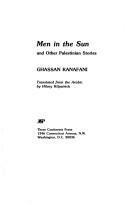
Men in the Sun
Ghassan Kanafani · 1936–1972 · Palestine
Originally Rijal fi al-Shams (Arabic) · translated by Hilary Kilpatrick
Why it matters
Three Palestinians cross the desert hidden in an empty water tank, seeking work in Kuwait. Kanafani compresses exile and dispossession into an unbearable parable: the defining fiction of the refugee experience.
At a glance
Short but structurally compressed, shifting between four perspectives with a spare, allegorical style.
Deep dive
Three Palestinian refugees strike a deal with a driver to smuggle them across the desert into Kuwait sealed inside an empty water tank, and Kanafani is far more interested in the fifteen minutes at the border checkpoint than in whether the plan works.
Written for readers who have finished the book. No plot recap, and nothing here is safe to read first.
Themes & symbolism
Abu Qais, Assad, and Marwan each carry a distinct, specific case of dispossession rather than a single symbolic wound: an older farmer who lost his land in 1948 and wants enough money to feel like a man providing for his family again, a young man fleeing debt and political trouble he can no longer outrun at home, a schoolboy forced to support his mother and siblings after his father abandons them for a new wife. Kanafani builds the men's desperation from these particulars precisely so the reader cannot mistake their situation for an abstraction.
Abul Khaizuran, the driver they pay to hide them, was made impotent by a wound suffered in the same 1948 fighting that dispossessed them, and Kanafani makes his injury the novella's central figure for a wider political emasculation, the humiliation of defeat carried in the body of the one man positioned to save or fail the others. His fatal delay at the border checkpoint, flirting with guards who tease him about a woman in Basra, is not incidental to that symbolism but its logical outcome: the same vanity that lets him prove he is still a man to strangers is what he chooses over the silent men baking inside his truck.
The men's decision to stay silent inside the tank rather than risk detection becomes Kanafani's bluntest political charge: a silence chosen for survival that Kanafani, writing as both novelist and later a spokesman for Palestinian political resistance, reads as the same silence he accused the wider Arab world of choosing after 1948, a quiet that looked prudent and cost everything.
A Writer Who Lived the Dispossession He Wrote
Kanafani was born in Acre in 1936 and fled with his family as a child during the 1948 war, growing up across refugee circuits in Lebanon and Syria before settling in Kuwait himself as a young teacher, the same route his three doomed characters are attempting. He later became a novelist, journalist, and spokesman for the Popular Front for the Liberation of Palestine, and was killed by a car bomb in Beirut in 1972, an assassination widely attributed to Israeli intelligence. That biography sits behind the novella's refusal of sentimentality: Kanafani was not imagining refugee desperation from a safe distance, he had lived versions of every leg of his characters' route.
The last seal: what actually happens, and why it lands the way it does.
The ending, explained
Abul Khaizuran's delay at the border, just long enough to indulge the guards' teasing about his romantic reputation, costs the three men their lives: by the time he reaches the far side and opens the tank, Abu Qais, Assad, and Marwan have suffocated in the desert heat. He dumps their bodies on a garbage heap outside Kuwait City rather than risk exposure, and the novella's final line has him screaming at the corpses, asking why none of them banged on the tank's walls to be let out. The question is aimed less at three dead men than at the Arab world Kanafani is accusing of the same failure: waiting silently for rescue instead of making enough noise to demand it.
Where to go next
 Ghassan Kanafani · 1969Returning to HaifaLvl 5Medium pace
 Nawal El Saadawi · 1975Woman at Point ZeroLvl 3Fast paced
 Abdul Rahman Munif · 1984Cities of SaltLvl 6Slow burn
 Alaa Al Aswany · 2002The Yacoubian BuildingLvl 4Fast paced
 Emile Habibi · 1974The Secret Life of Saeed the PessoptimistLvl 6Fast paced
 Mahasweta Devi · 1974Mother of 1084Lvl 5Medium pace