
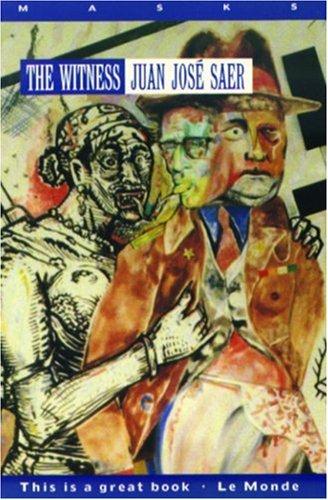
The Witness
Juan José Saer · 1937–2005 · Argentina
Originally El entenado (Spanish) · translated by Margaret Jull Costa
Why it matters
The sole survivor of a massacred sixteenth-century Spanish expedition is adopted, then returned, by an Indigenous tribe whose worldview he can never fully translate. Saer treats memory and perception with near-philosophical rigor.
At a glance
Dense, meditative prose interrogates memory and perception more than it tells a story.
Deep dive
Saer's narrator spends his whole life performing a captivity story for people who can never actually understand what happened to him — including, he suspects, himself.
Written for readers who have finished the book. No plot recap, and nothing here is safe to read first.
Themes & symbolism
The cabin boy's decade among the tribe that killed and ritually consumed the rest of his landing party is framed less as adventure or trauma than as an encounter with a cosmology his own language will never fully carry back. Saer treats the cannibalism itself with anthropological seriousness rather than horror, insisting that ritual consumption makes sense within a worldview the narrator can inhabit but never translate — every attempt he later makes to narrate his captivity for European audiences is necessarily a reduction, a domesticated version of something that resists domestication. The novel's real subject is this gap between lived experience and transmissible narrative, dramatized through a survivor whose entire subsequent career becomes retelling a story he knows he can't actually tell.
Saer's prose, dense and philosophically deliberate, treats memory and perception as constructions rather than simple records of fact, which is why the narrator's account resists settling into a clean captivity narrative even on its own terms. The boy's usefulness to the tribe — precisely because he is young and outside their own kinship structures, a vessel for witnessing rather than a participant with a stake in their world — makes him a witness in the most literal and most compromised sense: present for everything, capable of explaining almost none of it, and aware of that incapacity in a way that only deepens with age.
An inverted captivity narrative
The genre this novel gestures at — the European captivity narrative — typically assumes an audience's own civilization is the real, stable identity that captivity temporarily interrupts. Saer reverses the polarity entirely. By the narrator's old age, his decade among the tribe is the only period he can point to as fully, vividly lived; his European life before and after reads by comparison as secondhand and pale. The captivity isn't the interruption of his real life — it is his real life, and the rest is the estrangement.
Memory as unreliable construction
Saer is less interested in what actually happened during the narrator's captivity than in what it means to try to recover and narrate an experience decades later, filtered through a language and audience unequipped for it. The novel's philosophical density comes from treating this problem — the constructedness of memory, the impossibility of neutral witness — as seriously as any of its historical or anthropological material, which is why the book reads closer to a meditation on perception than to a historical adventure.
The last seal: what actually happens, and why it lands the way it does.
The ending, explained
Looking back from old age, the narrator arrives at an inversion of what a captivity narrative is supposed to conclude: the decade spent among the tribe, not his subsequent decades of ordinary Spanish colonial life, is what he recognizes as having actually been real. His European existence, both before capture and long after his return, feels comparatively secondhand — a life observed rather than lived. That his professional adulthood becomes performing a simplified version of his own captivity for audiences who can't receive the real thing only deepens the irony: the one experience that made him feel fully present is also the one he's condemned to falsify every time he tells it.
Where to go next
 Adolfo Bioy Casares · 1940The Invention of MorelLvl 5Fast paced
 César Aira · 1990GhostsLvl 5Slow burn
 Jorge Luis Borges · 1944FiccionesLvl 7Slow burn
 Ricardo Piglia · 1980Artificial RespirationLvl 8Slow burn
 Augusto Roa Bastos · 1974I, the SupremeLvl 9Slow burn
 Mariano Azuela · 1915The UnderdogsLvl 4Fast paced