
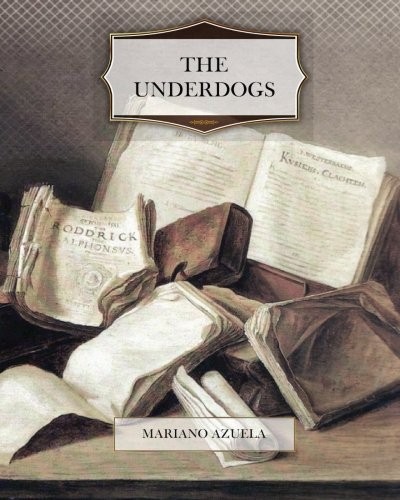
The Underdogs
Mariano Azuela · 1873–1952 · Mexico
Originally Los de abajo (Spanish)
Why it matters
A peasant band is swept into revolutionary violence they barely understand or control. Written amid the actual fighting, it remains the Mexican Revolution's first great, unheroic novel.
At a glance
Episodic, fast-moving chapters follow chaotic violence without much interior reflection.
Deep dive
Why the novel keeps its revolutionaries too busy looting and drifting to ever explain what, exactly, they're fighting for.
Written for readers who have finished the book. No plot recap, and nothing here is safe to read first.
Themes & symbolism
Azuela was writing from inside the actual fighting, not looking back at it from the safety of later nation-building myth, and that proximity produces a revolution experienced almost entirely as chaos rather than cause: Demetrio Macías's band grows because vengeance, plunder, and escape from poverty are available now, not because anyone has settled what a Villista or a Carrancista victory would actually mean. The men follow shifting factional lines they barely track, commit their own casual atrocities as readily as they fight for anything nameable, and the novel refuses the later revolutionary mythology's insistence that this violence was building toward a coherent national future.
Luis Cervantes, the opportunistic former Federalist medical student who joins for personal advancement rather than conviction, and the women Camila and War Paint, whose presence exposes the casual sexual violence running through the band's daily life, populate a structure that is episodic on purpose, mirroring the real disorganization of much of the ground-level fighting. The novel's famous unheroism isn't cynicism for its own sake; it's testimony, close enough to the actual chaos that it can't afford the tidy arc later accounts would impose on the same events.
Demetrio's own rise carries none of the ideological clarity later revolutionary iconography would attach retroactively to figures like him; he becomes a leader because he is brave and locally respected, not because he has articulated any vision of what a post-war Mexico should look like, and his band's swelling ranks track opportunity and grievance far more closely than they track political conviction. Azuela lets that gap between the revolution's later myth and its lived, confused reality stand without editorial comment, trusting the accumulation of small, ugly episodes to make the argument the narration itself refuses to state outright.
Written while the guns were still firing
Azuela served as a doctor with revolutionary forces while composing this novel, and that eyewitness proximity shows in its refusal of retrospective clarity: there is no vantage point in the book from which the revolution's larger meaning becomes visible, because the author didn't have one either. This makes The Underdogs less a historical novel about the Mexican Revolution than a document produced by it, the first great unheroic account of an event later Mexican culture would spend decades trying to render heroic. Later Mexican literature and muralism would spend generations building a redemptive national mythology on top of exactly this period, which makes Azuela's refusal to supply one, from inside the fighting itself, feel less like an oversight than a deliberate, stubborn honesty.
The last seal: what actually happens, and why it lands the way it does.
The ending, explained
As the revolution's political currents shift away from him and his band is worn down by successive engagements, Demetrio keeps fighting less from conviction than from a fatalistic sense that he has no other life left to return to. He leads his remaining men back to the same canyon pass where the novel opened and is ambushed and killed there, a deliberately circular ending that denies the war any triumphant resolution. The revolution simply consumes the ordinary men swept into it and deposits them, literally, back where they started, with nothing personally redemptive or nationally transformative that the novel is willing to affirm on their behalf. The return to the exact same geography he started from is the whole point: whatever this war was for, it was never for him, and the landscape itself outlasts every man who passed through it.
Where to go next
 Horacio Quiroga · 1917Stories of Love, Madness, and DeathLvl 4Fast paced
 Rómulo Gallegos · 1929Doña BárbaraLvl 4Medium pace
 Ricardo Güiraldes · 1926Don Segundo SombraLvl 5Medium pace
 Elena Garro · 1963Recollections of Things to ComeLvl 7Slow burn
 Augusto Roa Bastos · 1974I, the SupremeLvl 9Slow burn
 Juan José Saer · 1983The WitnessLvl 7Slow burn