
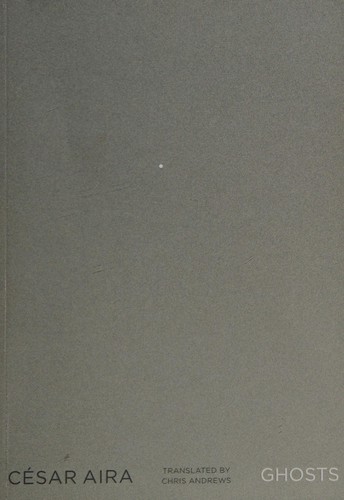
Ghosts
César Aira · b. 1949 · Argentina
Originally Los fantasmas (Spanish) · translated by Chris Andrews
Why it matters
A family of construction-site watchmen live alongside ghosts wandering the unfinished building's bare floors on New Year's Eve. Aira's mundane and impossible occupy the same flat, unhurried plane, written at his characteristic breakneck speed.
At a glance
Flat, deadpan prose treats ghosts and mundane domestic life as equally unremarkable.
Deep dive
Aira spends the whole novel proving that a nude ghost drifting through wet concrete and a family arguing over dinner belong in exactly the same sentence, at exactly the same emotional temperature.
Written for readers who have finished the book. No plot recap, and nothing here is safe to read first.
Themes & symbolism
The unfinished apartment building is the novel's central conceit made literal: a structure suspended between blueprint and completion, inhabited by construction workers whose own economic situation is just as unfinished and provisional. The ghosts who wander its bare floors — dust-covered, casually present, feared by no one — aren't intrusions into this world so much as its logical extension: beings caught permanently between states, just like the building and just like the immigrant family living inside it. Aira never dramatizes the ghosts as uncanny. They're treated with the same deadpan attention as a stew being cooked or a family argument, and that flatness is the book's whole method — refusing to rank the supernatural above the domestic forces the reader to notice how strange the domestic already is.
Patri's invitation to the ghosts' New Year's party turns the novel's structural in-betweenness into a coming-of-age threshold: a teenage girl poised between childhood and adulthood is offered passage into another kind of unfinished state altogether. Aira's famous compositional method — writing forward at speed without revision, folding in whatever tangent or apparent inconsistency arises rather than correcting it — mirrors the ghosts' condition formally: a text that never resolves into a final, settled draft, staying suspended the way the building and its residents stay suspended. The mundane and the impossible sharing one flat plane isn't just a stylistic tic; it's Aira's argument that reality itself, for people living precariously, already has this quality of being incomplete and haunted.
Aira's fuga hacia adelante
Aira has described his method as a 'flight forward' — he drafts in longhand, rarely revises, and simply keeps writing through anything that in a more conventional process would prompt a rewrite. Ghosts reads like the product of that method: digressive riffs on construction techniques or family history sit beside the supernatural plot without any effort to smooth the transitions. The unrevised quality isn't sloppiness; it's a formal commitment to keeping the text itself unfinished, in sympathy with a building that never gets completed and ghosts who never fully arrive anywhere.
A family on the site, not in the building
Raúl Viñas and his family occupy the construction site rather than the finished apartments they're guarding — a distinction Aira keeps quietly present throughout, since it means the family's domestic life (meals, arguments, a daughter's restlessness) plays out in the same bare, provisional rooms the ghosts drift through. Their labor secures a comfort that will belong to someone else once the building is finished and they move on to the next site, which gives their own condition an unfinished, transient quality well before any ghost enters the picture. The novel's supernatural element reads, in this light, less like an intrusion of the fantastic than like a magnification of a precarity the family is already living inside.
The last seal: what actually happens, and why it lands the way it does.
The ending, explained
At the ghosts' midnight party, Patri is invited to eat and drink with them — an offer that, given what the ghosts seem to represent, would mean crossing over into their suspended state. Aira never clarifies whether she accepts, whether acceptance would mean literal death, or whether the entire scene is closer to a symbolic rite of passage than a literal transaction. The ambiguity is the point: the New Year functions as a threshold in time just as the ghosts function as beings at a threshold in existence, and Patri's encounter with them is written in the same untroubled prose as everything preceding it, refusing to escalate into horror or tragedy even as it leaves her fate genuinely open.
Where to go next
 César Aira · 1997The Literary ConferenceLvl 5Fast paced
 Jorge Luis Borges · 1944FiccionesLvl 7Slow burn
 Adolfo Bioy Casares · 1940The Invention of MorelLvl 5Fast paced
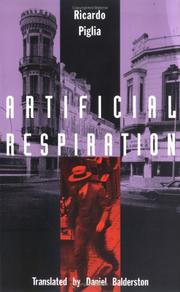 Ricardo Piglia · 1980Artificial RespirationLvl 8Slow burn
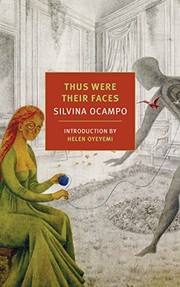 Silvina Ocampo · 1959Thus Were Their FacesLvl 5Fast paced
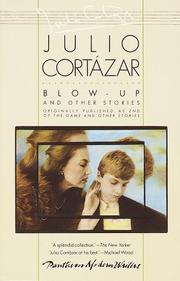 Julio Cortázar · 1959Blow-Up and Other StoriesLvl 6Medium pace