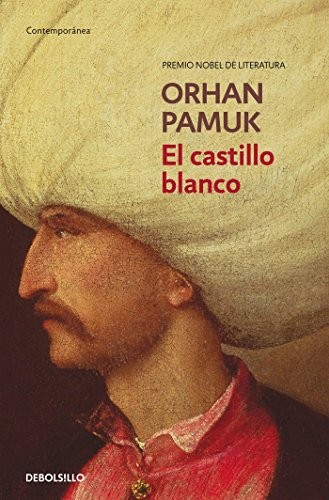
The White Castle
Orhan Pamuk · b. 1952 · Turkey
Originally Beyaz Kale (Turkish) · translated by Victoria Holbrook
Why it matters
An enslaved Venetian scholar and the Ottoman polymath he physically resembles spend years trading knowledge and stories until the line between master and slave starts to blur. Pamuk's first major novel, and his first parable of East, West, and the self as something borrowed.
At a glance
A short, controlled fable, though its final identity swap unsettles everything read before it.
Deep dive
A Venetian scholar captured by Ottoman pirates ends up sharing a study, and an uncanny resemblance, with a Turkish scholar obsessed with mastering everything the West apparently knows, and the two men's collaboration slowly stops being clear about which of them is actually the captive.
Written for readers who have finished the book. No plot recap, and nothing here is safe to read first.
Themes & symbolism
The unnamed Italian narrator, taken prisoner after his ship is seized by Ottoman forces, is given to Hoja, an Istanbul scholar who notices, with an unease neither man ever fully names, that the two of them look almost identical. Pamuk builds the entire novel around what that resemblance does to their working relationship: Hoja extracts the narrator's Western scientific and cultural knowledge for his own advancement at the Sultan's court, first through astrology and clockwork, later through an ambitious war machine, while insisting on the master-slave hierarchy between them even as the intellectual traffic increasingly runs both directions.
The two men's collaborative writing project, in which Hoja compels the narrator to catalog everything shameful or sinful about himself as a kind of confession Hoja then studies and absorbs, becomes Pamuk's clearest device for eroding the boundary between self and other: Hoja does not merely learn the narrator's knowledge, he starts internalizing his psychology, his guilt, his specific memories, until the novel stops giving readers reliable footing for deciding which man's interiority any given passage is actually describing. Pamuk sets this exchange during a seventeenth-century plague outbreak that empties the streets around them, so that the two men's growing entanglement plays out inside a city already emptying itself of the fixed social roles, master, slave, Ottoman, Venetian, that would otherwise have kept the two men legibly distinct.
The War Machine as East-West Collaboration's Failure Point
Hoja's years of study culminate in an elaborate siege weapon he convinces the Sultan to fund for a campaign against the Polish-held white castle of the title, and its total failure in the field, useless against actual battlefield conditions despite all the theoretical sophistication poured into it, becomes Pamuk's bleakest joke about the entire exchange the novel has tracked: absorbing another culture's science does not automatically transfer its practical mastery, and the gap between the two very nearly gets both men executed.
The last seal: what actually happens, and why it lands the way it does.
The ending, explained
Facing the Sultan's fury after the war machine's failure, Hoja abandons his old identity entirely, taking the narrator's place and papers to escape into Venice and the narrator's former life there, while the narrator remains behind in Istanbul, assuming Hoja's name, possessions, and position at court. Pamuk gives no definitive account of which man actually made this choice or how willingly the other went along with it, and the narrator's own retrospective telling, now old and settled in Hoja's former household outside Istanbul with a family of his own, keeps circling the question of whether he has simply become the man he once served. The novel closes without resolving whether an authentic self survives this kind of total exchange, or whether identity itself, for Pamuk, was always this unstable to begin with, one thorough enough exposure to another person's demands away from disappearing.