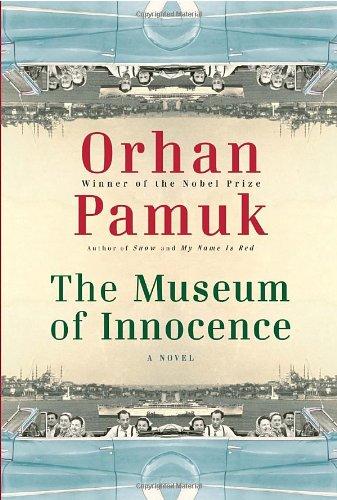
The Museum of Innocence
Orhan Pamuk · b. 1952 · Turkey
Originally Masumiyet Müzesi (Turkish) · translated by Maureen Freely
Why it matters
A wealthy Istanbul man's obsession with a poor young relative curdles into decades of hoarding every object she's touched, assembled at last into a literal museum. Pamuk's vast, aching study of love as collection and captivity.
At a glance
A slow-accumulating, obsessive narration over decades rewards patience more than pace.
Deep dive
A wealthy Istanbul man's affair with a poor distant cousin ends the summer it begins, and he spends the next eight years finding reasons to sit at her family's dinner table anyway, pocketing something of hers every time he leaves.
Written for readers who have finished the book. No plot recap, and nothing here is safe to read first.
Themes & symbolism
Kemal is thirty and engaged to Sibel, a woman from his own wealthy Nişantaşı circle, when he begins an affair with Füsun, an eighteen-year-old distant relative working in a shop, and Pamuk spends the novel's opening chapters establishing just how casually Kemal assumes he can have both, the engagement and the affair, and eventually, he tells himself, a marriage to Füsun once enough time has passed. That assumption collapses almost immediately: Füsun disappears from his life once the affair becomes impossible to sustain, and the rest of the novel tracks what Kemal does with the eight years it takes him to find his way back into her company, engineering, then treasuring, an invitation to near-nightly dinners at her family's modest apartment, where Füsun is now married to an aspiring filmmaker named Feridun.
Kemal's solution to a love he cannot act on is to collect it, literally, in the form of thousands of objects Füsun has touched: earrings, hair clips, a salt shaker from the dinner table, and by his own eventual count, 4,213 of Füsun's cigarette butts, each one dated and annotated with what was said that evening. Pamuk treats this hoarding without irony as both pathology and devotion, an act of curatorial patience so extreme it becomes its own kind of intimacy, since across 1,593 recorded dinners, Kemal is present for the whole slow, unglamorous texture of Füsun's actual life, her father's illness, her ambitions, her boredom, in a way infatuation from a distance never could have offered him.
Pamuk sets this private obsession against Istanbul's own passage from a more traditional, class-bound city in the 1970s toward the Westernizing, consumerist metropolis of later decades, and Kemal's museum-in-waiting doubles as an accidental social history, cinema tickets, beauty-contest ephemera, the brand names and furniture of a specific vanished middle-class Istanbul, all preserved because they happened to be near Füsun when Kemal was in the room. The novel's conceit, that Kemal eventually narrates this whole story as the catalog for an actual museum he has built from the collection, makes Pamuk's argument explicit: obsessive love and the museal impulse to preserve and label are, for Kemal, functionally the same activity.
A Museum Pamuk Actually Built
Pamuk did not stop at the novel's conceit: in 2012 he opened a real Museum of Innocence in Istanbul's Çukurcuma neighborhood, a restored townhouse filled with vitrines corresponding chapter by chapter to Kemal's collection, cigarette butts, hairpins, a porcelain dog, ticket stubs, curated with the same obsessive specificity the novel describes. The book even ships with a coupon for free admission, collapsing fiction and institution so thoroughly that visitors walk through Kemal's private hoarding as an actual public exhibit, an experiment in taking a novel's central metaphor and building it, brick by vitrine, in the real city the story is set in.
The last seal: what actually happens, and why it lands the way it does.
The ending, explained
Kemal finally gets his chance at a life with Füsun once her marriage to Feridun ends, and the two of them set off on what plays as a honeymoon trip through Europe, the culmination of everything Kemal spent nearly a decade waiting for. On the drive home, with the two of them finally, briefly, at ease with each other, Füsun crashes the car and dies from the injuries; Pamuk leaves open whether the crash was an accident or Füsun's own final, furious response to the years Kemal's hesitation cost her. Kemal spends the rest of his life turning Füsun's family's old apartment into the museum the novel has been quietly describing all along, and commissions a novelist named Orhan Pamuk, whom he meets late in life, to tell the story properly, so that the book ends by explaining its own origin as an object inside the very collection it describes.