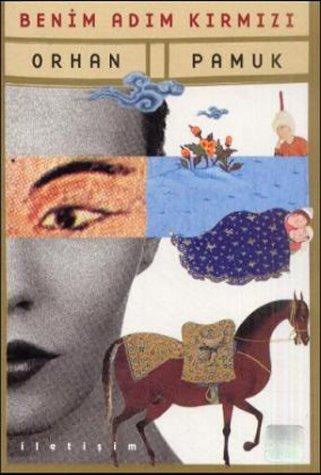
My Name Is Red
Orhan Pamuk · b. 1952 · Turkey
Originally Benim Adım Kırmızı (Turkish) · translated by Erdağ Göknar
Why it matters
A murdered miniaturist narrates his own death as Ottoman artists debate whether style itself is sin: a mystery, a romance, and an essay on East, West, and seeing. The novel that carried Pamuk to the Nobel.
At a glance
Rotating first-person narrators, including objects and a corpse, layered with art-historical digression.
Deep dive
A murder mystery where the coin, the dog, and the color red all take a turn narrating — and where the real defendant on trial is the idea of an individual artistic signature.
Written for readers who have finished the book. No plot recap, and nothing here is safe to read first.
Themes & symbolism
The novel's real argument is a collision between two theories of vision. The Herat tradition Pamuk's miniaturists were trained in holds that a master paints the world as Allah sees it: timeless, unindividuated, ideally repeated from memory rather than observed fresh, so faithfully that going blind is not a tragedy but the natural end point of a life spent internalizing the great masters' compositions. Against this stands the Venetian innovation of perspective and portraiture, which fixes one mortal eye in one place at one moment and lets the artist's hand become visible as style — a signature where there should be none. Enishte's secretly commissioned book, blending the two, isn't just aesthetically transgressive; it's read by the old guard as a theological threat, since claiming a personal way of seeing competes with God's exclusive, timeless one. That's the stake that makes murder proportionate to a painting.
The novel dramatizes this same debate in its own form: chapters narrated in turn by a corpse, a coin, a dog, a horse, a tree, and the color red itself refuse to let any one perspective claim authority, which is exactly the cover the murderer needs to hide inside a chorus of voices before his own confession arrives, unnamed, among the rest. Red's chapter — insisting color has no memory and needs no meaning beyond its own presence on the page — is a rebuttal in miniature to the melancholic historicism of the human narrators, arguing for surface and pleasure over interpretation. The courtship plot mirrors the murder plot: Shekure manages the men around her by withholding exactly enough, and Black spends the book trying to read her face the way a miniaturist reads a subject for concealed feeling, where a wrong guess costs as much as a wrong accusation.
Style Becomes the Confession
The novel's cruelest irony is formal: despite the old masters' fantasy that a truly disciplined hand leaves no personal trace, it's a small, involuntary habit — the particular way a suspect draws a horse's nostril — that finally unmasks the killer. Every philosophical argument in the book insists individual style can and should be suppressed for the sake of a shared, timeless tradition; the plot itself insists otherwise, since not even the most orthodox miniaturist can fully erase himself from his own line. Pamuk lets the mystery-novel mechanics settle an argument the characters' theology can't. Master Osman, given the chance late in the book to confirm the murderer's identity from the workshop's old drawings, chooses blindness over that confirmation instead — a final, willed act of loyalty to the anonymous tradition he's spent his life serving, even at the cost of leaving Black's investigation to finish itself without him.
The last seal: what actually happens, and why it lands the way it does.
The ending, explained
The murderer turns out to be Olive, whose unnamed chapters have been threaded through the book — driven by a genuine, not merely opportunistic, terror that the new Frankish-influenced manuscript amounts to heresy, compounded by professional jealousy and a desire to control its fate himself. Black identifies him through that telltale drawing habit and kills him in the climactic confrontation rather than handing him to formal justice. Black then marries Shekure, closing the courtship plot on a note of hard-won domestic settlement rather than triumph. The illustrated manuscript that cost three men their lives is never definitively finished, judged, or destroyed on the page — its heresy or genius, like the East-West argument it embodies, is left open rather than resolved.