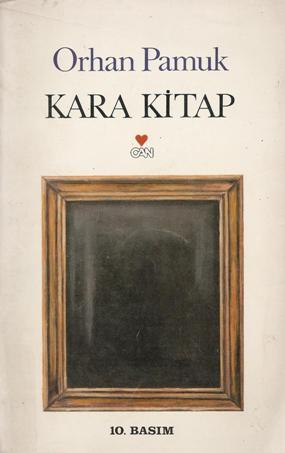
The Black Book
Orhan Pamuk · b. 1952 · Turkey
Originally Kara Kitap (Turkish) · translated by Maureen Freely
Why it matters
An Istanbul lawyer searches the city for his vanished wife and her half-brother, a columnist whose old newspaper pieces start rewriting the search itself. A metaphysical detective novel that turns into a meditation on identity, doubling, and the city as text.
At a glance
Interpolated newspaper columns and a labyrinthine, digressive structure blur searcher and searched-for.
Deep dive
An Istanbul lawyer's wife disappears along with her older half-brother, a newspaper columnist with a citywide readership, and the search for both slowly requires the lawyer to stop being himself.
Written for readers who have finished the book. No plot recap, and nothing here is safe to read first.
Themes & symbolism
Galip is a thirty-something Istanbul lawyer who wakes to find his wife Rüya gone, with only a brief note promising she will be in touch, and his first working theory, that she has left him for her older half-brother Celal, a newspaper columnist famous enough that strangers stop him in the street to discuss that morning's piece, sends him wandering the city rather than filing a report. Pamuk keeps the search almost entirely pedestrian: teahouses, cinema lobbies, secondhand bookshops, mannequin workshops, so that Istanbul itself, in its specific decaying Ottoman apartment blocks and Cold War-era paranoia, becomes as fully a character as anyone Galip actually questions. What starts as a missing-persons plot keeps refusing to behave like one, since clues lead not toward Rüya but toward Celal's old columns, which Galip begins rereading obsessively for buried instructions.
The novel's most unsettling turn is how completely Galip comes to occupy Celal's life rather than simply search for him: he lets himself into Celal's abandoned apartment, wears his clothes, adopts his voice on the phone with anxious readers, and eventually starts writing new newspaper columns under Celal's byline, ones that Istanbul's editors run without asking too many questions about their author's whereabouts. Pamuk is explicit that this is not disguise but genuine displacement, the longer Galip performs Celal, the less either man remains a stable point the narrative can return to, and by the second half of the book it is often unclear whether a given passage belongs to Galip's search or to Celal's own writing, recovered or invented.
Underneath the doubling sits a stranger, older argument about Istanbul itself as a text to be decoded. A recurring subplot follows a mannequin-maker who spent decades trying to sculpt authentically Turkish faces rather than European ones, and a cast of Hurufi mystics convinced that Arabic letters are hidden in the human face and that a sufficiently careful reader can find secret meaning anywhere, a newspaper column, a shop window, a stranger's expression. Pamuk lets these plots rhyme rather than resolve: Celal's readers, hunting his columns for coded messages meant just for them, are doing exactly what the mannequin-makers and letter-mystics do, treating the city and its texts as ciphers with an answer underneath, when the novel's real suggestion is that meaning here is manufactured by the searching itself.
A City of Readers Convinced the Text Is About Them
Celal's column functions less like journalism than a decades-long relationship with an audience that has quietly decided he is writing to them personally, and Pamuk stages that delusion at full, dangerous scale: the man eventually implicated in tracking Celal down through Galip believes, with total sincerity, that certain columns encode a private message about his own marriage. It is a satirical portrait of celebrity as much as a mystical one, the specific derangement of a mass audience convinced that a public text was actually written in secret for an audience of one, and Pamuk treats that conviction as no less dangerous, or contagious, for being irrational.
The last seal: what actually happens, and why it lands the way it does.
The ending, explained
Celal is shot dead on an Istanbul street, and Rüya's body is found soon after inside a neighborhood shop, also shot; Pamuk never confirms a single, stable account of who killed either of them or why, though the strongest thread points to a jealous, obsessive reader who had convinced himself Celal's columns concerned his own wife. Galip, rather than solving the murders in any satisfying procedural sense, simply continues: he keeps living in Celal's apartment and keeps filing columns under Celal's name, so that the search for a missing man ends with Galip permanently becoming him. The mystery plot resolves into death without resolving into explanation, and Pamuk's real payoff is that Galip's transformation, the thing the whole novel has actually been tracking, completes itself exactly when the people he loved are no longer around to notice.