
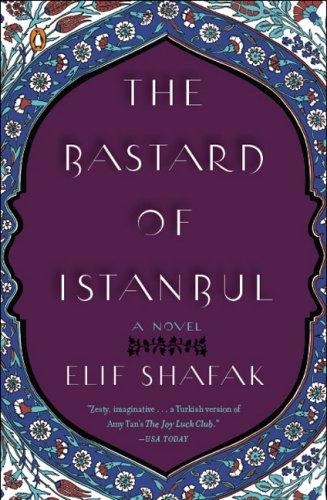
The Bastard of Istanbul
Elif Shafak · b. 1971 · Turkey / UK
Why it matters
An Armenian-American family and their Turkish counterparts are entwined around the buried memory of the 1915 genocide. Shafak was prosecuted in Turkey for 'insulting Turkishness' over this novel's frankness.
At a glance
Large dual-family cast and dual timelines, but rendered in clear, propulsive contemporary prose.
Deep dive
Two households, one raising its daughters on a menu of family curses and denial in Istanbul, the other keeping a diaspora's exact grief alive in San Francisco, turn out to be connected in ways neither has any reason to expect before a nineteen-year-old shows up on the wrong doorstep.
Written for readers who have finished the book. No plot recap, and nothing here is safe to read first.
Themes & symbolism
Asya Kazancı grows up in an Istanbul household of women, her aunts Cevriye, Feride, and Banu, her grandmother Gülsüm, and her mother Zeliha, who raised her more as a family project than as an acknowledged daughter, since no one in the house will say who Asya's father is. Across the Atlantic, Armanoush Tchakhmakhchian is raised inside an Armenian-American family whose diaspora identity is organized entirely around remembering 1915, generations of an American upbringing pressed hard against grandparents who insist she recite her family history like scripture. When Armanoush secretly flies to Istanbul to see the city her family was driven from, she moves into the Kazancı household through her stepfather Mustafa, Zeliha's long-absent brother, without either family realizing yet how directly their histories are already knotted together.
Shafak stages the Armenian genocide as the fault line the two households handle in opposite ways, the Tchakhmakhchians treating memory as an inheritance owed to the dead, the Kazancı women having absorbed, without ever quite deciding to, a Turkish habit of not naming what happened at all. Asya's own creed, a personal manifesto of belonging to nothing, refusing nation, family, or cause alike, reads at first as generational nihilism and gradually as the psychologically logical response to being raised inside a house built entirely on things left unsaid.
Banu's fortune-telling, aided by two djinns she keeps as informants on the family's past, gives the novel license to surface the buried Kazancı history through something other than confession, and the aşure Banu prepares near the novel's end, a pudding traditionally made from whatever grains and dried fruit are left in the pantry, becomes Shafak's clearest image for the book's argument: that a family, like a nation, survives on what it has managed to save from disaster and is willing to mix together rather than sort out.
A Novel Prosecuted for Its Characters' Opinions
Months after publication, Shafak was charged under Turkey's Article 301 for denigrating Turkishness, not for anything written in her own voice but for lines given to her fictional Armenian characters describing the massacres of 1915. The trial, which drew international attention to Turkey's speech laws, ended in acquittal after less than two hours, but the fact that a novel's dialogue could be treated as courtroom evidence became, for readers on both sides of the border the book is set across, part of the story of what The Bastard of Istanbul actually did.
The last seal: what actually happens, and why it lands the way it does.
The ending, explained
Banu's djinns eventually deliver the truth the whole household has organized itself around avoiding: Mustafa is not only Zeliha's brother, he raped her as a teenager, and Asya is his daughter rather than the fatherless child the family has always treated her as. Rather than expose Mustafa on his return visit to Istanbul, Banu poisons the portion of aşure she serves him, killing him in an act she understands as justice sanctioned by what her djinns have shown her rather than a crime of her own. The revelation retroactively explains the family's decades of evasions, from Zeliha's refusal to name Asya's father to Gülsüm's blanket silence, as protective rather than merely secretive. Armanoush leaves Istanbul having found something closer to an answer about her Armenian family's history than about the Turkish one she married into by accident, and the novel closes without granting either family a clean reconciliation, only the sense that both households have been keeping the same kind of silence for different reasons.
Where to go next
 Elif Shafak · 2009The Forty Rules of LoveLvl 4Fast paced
 Elif Shafak · 201910 Minutes 38 Seconds in This Strange WorldLvl 5Medium pace
 Orhan Pamuk · 1998My Name Is RedLvl 7Medium pace
 Alaa Al Aswany · 2002The Yacoubian BuildingLvl 4Fast paced
 Han Kang · 2007The VegetarianLvl 6Fast paced
 Jenny Erpenbeck · 2015Go, Went, GoneLvl 5Medium pace