
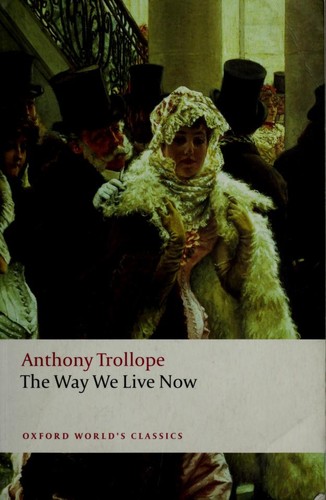
The Way We Live Now
Anthony Trollope · 1815–1882 · England
Why it matters
A fraudulent financier's rise and fall exposes a London society corrupted by speculation and social climbing. Trollope's late, angry masterpiece reads like it was written about any financial bubble since.
At a glance
A very long, densely populated social canvas with many subplots.
Deep dive
A financier nobody can quite verify becomes the most powerful man in London purely because everyone needs him to be real, and Trollope watches the whole city choose the lie.
Written for readers who have finished the book. No plot recap, and nothing here is safe to read first.
Themes & symbolism
Augustus Melmotte's rise — a financier of murky, possibly Continental origin whose enormous, largely undocumented fortune buys him a seat in Parliament, a place at the center of London society, and control of a fraudulent American railway scheme nobody fully understands but everyone wants to invest in — is Trollope's most direct and angriest satire of a society that has stopped asking whether wealth is real and started only asking whether it can be borrowed against. Nearly every character orbiting Melmotte, aristocrats included, knows or half-knows something is wrong and invests anyway, because the alternative to trusting Melmotte is admitting that their own genteel world is running on credit it can't otherwise sustain.
The marriage plot around Melmotte's daughter Marie — pursued by the worthless, debt-ridden aristocrat Sir Felix Carbury purely for her father's money, and eventually engineering her own escape from both her father's control and Felix's exploitation — mirrors the novel's financial plot exactly: marriage, like the railway shares, is being treated by nearly everyone involved as a speculative instrument, a way of converting one kind of currency (rank, beauty, connections) into another (cash), and Marie's late, hard-won insistence on choosing her own terms is one of the only places in the novel where a character successfully refuses to be traded.
Trollope's title is a direct editorial thesis rather than a neutral description: the novel is explicitly an indictment of a whole social order — aristocrats willing to lend their names and titles to a swindler they suspect is fraudulent because they need his money, a press willing to be bought, a Parliament willing to seat a man nobody has vetted — and Lady Carbury, Sir Felix's mother, churning out a wretched, flattery-dependent novel of her own to keep the family solvent, extends the corruption explicitly into the literary marketplace Trollope himself worked within, making this one of the rare Victorian novels willing to indict its own trade alongside the City and the aristocracy.
Trollope's Angriest Book
Written after a period abroad that left Trollope startled by how much English public morality had degraded in his absence, The Way We Live Now (1875) is markedly darker and more satirical than the warmer Barsetshire novels that made his reputation two decades earlier, trading their affectionate comedy for something closer to open contempt for a commercial culture Trollope saw as corrupting everything it touched, from Parliament to marriage to publishing. Its reputation dipped for decades after his death, dismissed by some as too cynical to sit alongside his gentler work, before a major mid-twentieth-century critical revival recast it as his most prescient and structurally ambitious novel — one modern readers have repeatedly found eerily contemporary in its portrait of a fraud too large, and too useful to too many people, to be stopped before it collapses under its own weight.
The last seal: what actually happens, and why it lands the way it does.
The ending, explained
As scrutiny of the railway scheme catches up with him — forged signatures, mounting debts, a disastrous drunken appearance in the Commons — Melmotte's support collapses overnight, the same society that lent him its name now competing to distance itself fastest. Rather than face arrest, he returns home and poisons himself, dying alone and unmourned in the study where he built his brief empire, a deliberately anticlimactic death for a man who'd seemed too large to fail. Marie, having secured her own money separately, sails for America on her own terms rather than accept another arranged match, while Sir Felix is packed off in disgrace and Paul Montague marries Hetta Carbury — a conventional happy ending granted only to characters never swept into Melmotte's orbit, while London's institutions simply resume business as usual, already primed for the next Melmotte.
Where to go next
 Anthony Trollope · 1857Barchester TowersLvl 4Medium pace
 William Makepeace Thackeray · 1848Vanity FairLvl 5Medium pace
 Elizabeth Gaskell · 1855North and SouthLvl 4Medium pace
 Charles Dickens · 1861Great ExpectationsLvl 4Medium pace
 Emily Brontë · 1847Wuthering HeightsLvl 6Medium pace
 Jane Austen · 1813Pride and PrejudiceLvl 3Medium pace