
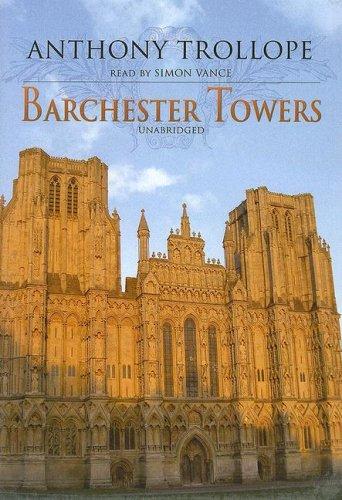
Barchester Towers
Anthony Trollope · 1815–1882 · England
Why it matters
A vacant bishopric sets off a comic war of ambition among clergy, wives, and hangers-on in a fictional cathedral town. Trollope's warm, exacting social comedy at its most purely enjoyable.
At a glance
Leisurely Victorian sentences, but the comic plotting is easy to follow.
Deep dive
A cathedral town goes to war over who gets to run an almshouse, and Trollope makes clerical ambition funnier than any battlefield.
Written for readers who have finished the book. No plot recap, and nothing here is safe to read first.
Themes & symbolism
The vacancy left by old Bishop Grantly's death sets off a contest that Trollope frames as pure comedy of manners even while taking its stakes — patronage, income, and institutional power within the Church of England — completely seriously: the new bishop, the weak and pliable Dr. Proudie, is really governed by his domineering wife Mrs. Proudie and her chosen chaplain, the unctuous, low-church careerist Obadiah Slope, and the novel's real conflict is less about theology than about who gets to control appointments, and therefore money and status, inside an institution everyone claims to be serving selflessly.
Mr. Slope's pursuit of both the wealthy widow Eleanor Bold and the vacant wardenship of Hiram's Hospital reveals him as Trollope's portrait of pure ecclesiastical opportunism, a man fluent in evangelical piety purely as a professional register rather than a felt belief, and his eventual defeat is engineered less by any single rival's cleverness than by his own overreach — trying to outmaneuver Mrs. Proudie, the one ally whose patronage actually made his rise possible, the moment he judges Eleanor's money makes her a better bet than continued deference to his patroness.
The Signora Madeline Neroni, the crippled, seductive daughter of the Stanhope family recalled from a long Italian sojourn, functions as the novel's disruptive outsider — reclining on her sofa, flirting shamelessly with both Slope and the ineffectual Bertie Stanhope's marriage prospects, she has no real stake in Barchester's clerical politics and uses that detachment to expose, with cheerful cruelty, exactly how much self-interest hides beneath everyone else's professed principle, culminating in her deliberately humiliating Slope in front of the bishop's garden party purely for her own amusement.
The Second Barsetshire Novel, and the One Readers Actually Love
Barchester Towers is the second of Trollope's six Chronicles of Barsetshire, following The Warden, and it's the volume that made the series and Trollope's early reputation, prized for a warmth and comic timing his later, more overtly satirical Barsetshire and Palliser novels sometimes trade away. Trollope famously breaks the fourth wall late in the novel to assure readers directly that Eleanor will not marry Slope, a narrative choice he defended against critics who thought it deflated suspense by arguing that a novel's pleasure lies in how a expected resolution is reached, not in withholding it as a cheap trick — a statement of Trollope's whole comic method, more interested in social texture and character than in plot mechanics for their own sake.
The last seal: what actually happens, and why it lands the way it does.
The ending, explained
Slope's scheme to secure the Hiram's Hospital wardenship for himself, hoping it will help win Eleanor, collapses once Mrs. Proudie — furious at his growing independence and open flirtation with the Signora — turns decisively against him and has him dismissed from the bishop's service, leaving him without patron, position, or bride; he departs Barchester in disgrace for an unglamorous London chaplaincy. The wardenship goes, in the end, to Mr. Harding's quiet return to a modest new post rather than to any scheming candidate, rewarding decency over ambition. Eleanor, long wrongly suspected by her own family of favoring Slope, instead marries the good-humored Reverend Francis Arabin, and Trollope closes with the tart observation that Mrs. Proudie, not Dr. Proudie, remains the diocese's real, undefeated power — the comic war ends with the same structure of influence reasserting itself under different names.
Where to go next
 Anthony Trollope · 1875The Way We Live NowLvl 5Medium pace
 William Makepeace Thackeray · 1848Vanity FairLvl 5Medium pace
 Elizabeth Gaskell · 1855North and SouthLvl 4Medium pace
 Charles Dickens · 1861Great ExpectationsLvl 4Medium pace
 Emily Brontë · 1847Wuthering HeightsLvl 6Medium pace
 Jane Austen · 1813Pride and PrejudiceLvl 3Medium pace