
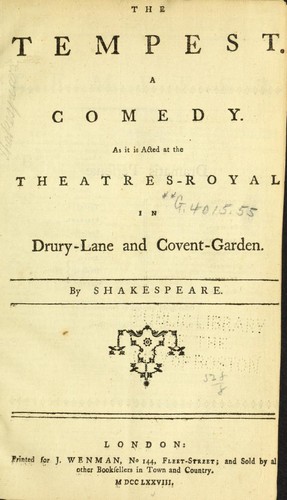
The Tempest
William Shakespeare · 1564–1616 · England
Why it matters
A sorcerer-duke shipwrecks his usurpers on his island, torments them with spirits, then chooses forgiveness and drowns his book. Shakespeare's late farewell to his own art, and, in Caliban, a text colonial writers have answered ever since.
At a glance
Short and fable-clear in plot, with late-style compression in the verse.
Deep dive
A deposed duke conjures a shipwreck to deliver his enemies onto the island where he's been marooned for a dozen years, and then has to decide, with all of them finally in his power, what he actually wants to do with them.
Written for readers who have finished the book. No plot recap, and nothing here is safe to read first.
Themes & symbolism
Prospero's opening account of his usurpation, a rightful Duke of Milan overthrown by his brother Antonio and set adrift with his infant daughter Miranda, frames everything that follows as a revenge plot, and his magic across the play, the storm that opens it, the illusions that torment his enemies, is aimed entirely at engineering a moment where Antonio, Alonso, and the rest are as powerless as he once was. Caliban's counter-claim, that the island was his mother Sycorax's and Prospero simply took it, sits underneath the play's revenge plot as an unresolved second usurpation the story never quite squares, Prospero styling himself the wronged party while occupying exactly the position he accuses his brother of.
Ariel and Caliban give the play its two models of unfree service: Ariel, an airy spirit Prospero freed from Sycorax's imprisoning tree, works toward an explicitly promised liberation, faithfully performing magic in exchange for a release date Prospero keeps postponing, while Caliban, taught language only to curse in it, has no such promise and no such faith, cursing his captivity from a position with no exit at all. The contrast lets Shakespeare stage colonization from both its more sympathetic angle, the compliant native who might yet be freed, and its harsher one, the resistant native offered nothing but subjugation, without the play ever fully endorsing either Prospero's authority or Caliban's rebellion.
Prospero's masque for Miranda and Ferdinand, interrupted by his sudden remembering of Caliban's murder plot, gives Shakespeare his most direct staging of art's own fragility, spirits vanishing into thin air mid-performance, and the famous 'our revels now are ended' speech extends that fragility to the world itself, life as another insubstantial pageant that will likewise dissolve. Written in Shakespeare's final years as a working playwright, the play's own self-consciousness about illusion and its ending, breaking the staff, drowning the book, has been read for centuries as Shakespeare staging his own retirement inside his character's.
Miranda's One Real Choice
Miranda, raised on an island with exactly two men she's ever known, her father and Caliban, before Ferdinand's shipwrecked arrival, has almost no autonomy in a plot her father has scripted from the opening scene, engineering the very shipwreck that produces her suitor and then testing Ferdinand's character before permitting the match. Her famous line on first seeing the shipwrecked Neapolitans, 'O brave new world, that has such people in't,' reads as either genuine wonder or dramatic irony depending on how much credit the production gives Prospero's manipulation, and Shakespeare leaves the ambiguity fully intact: Miranda's marriage looks like her own discovery and is also, visibly, her father's design.
The last seal: what actually happens, and why it lands the way it does.
The ending, explained
Prospero, with Antonio, Alonso, and the rest finally at his mercy through Ariel's illusions, chooses forgiveness over the revenge the whole play has built toward, on the announced principle that the rarer action is in virtue than in vengeance, restoring his dukedom through reconciliation rather than punishment. He frees Ariel as promised, releases Caliban to the island without granting him anything resembling justice for the original usurpation, and breaks his magic staff and drowns his books, surrendering the power that made the whole plot possible in the first place. The epilogue, spoken directly to the audience by Prospero out of character, asks for applause to free him from the stage the same way his own magic freed Ariel, collapsing the play's fiction and Shakespeare's theatre into the same closing gesture of a power voluntarily laid down.
Where to go next
 William Shakespeare · 1593Richard IIILvl 6Fast paced
 William Shakespeare · 1595Romeo and JulietLvl 4Fast paced
 William Shakespeare · 1596A Midsummer Night's DreamLvl 3Fast paced
 William Shakespeare · 1601HamletLvl 6Medium pace
 William Shakespeare · 1602Twelfth NightLvl 4Fast paced
 William Shakespeare · 1603OthelloLvl 6Fast paced