
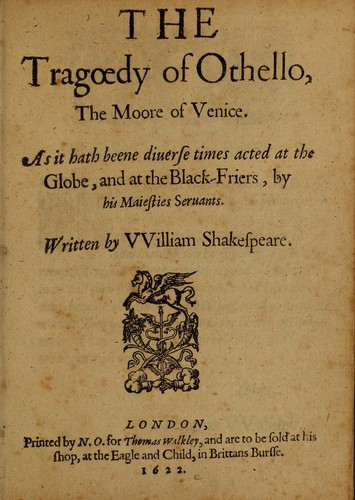
Othello
William Shakespeare · 1564–1616 · England
Why it matters
A Venetian general, a Moor and an outsider despite his rank, is destroyed not by a rival in battle but by the ensign he trusts most. Iago's unexplained hatred (Coleridge called it 'motiveless malignity') makes this Shakespeare's most claustrophobic tragedy: jealousy engineered by a genius of manipulation.
At a glance
Sustained psychological pressure and Iago's serpentine, persuasive rhetoric demand close attention.
Deep dive
A soldier trusted for his honesty destroys a marriage using nothing but suggestion and a dropped handkerchief, and Shakespeare never quite lets the audience settle on why he wants to.
Written for readers who have finished the book. No plot recap, and nothing here is safe to read first.
Themes & symbolism
Iago tells the audience more than one motive for hating Othello, passed over for promotion in favor of Cassio, a rumor that Othello has slept with his own wife Emilia, and each explanation arrives with just enough conviction to seem sufficient and just enough inconsistency with the others to seem insufficient, which is exactly the effect Coleridge was describing when he called Iago's hatred motiveless malignity: not that he has no reasons, but that the reasons never add up to the scale of what he does with them. Shakespeare gives Iago more soliloquies than almost any other character in the canon, more direct access to his own scheming, and yet the more he explains himself the less legible his actual interior becomes, a genius of manipulation whose deepest motive turns out to be manipulation itself.
Othello's status as a Moor and an outsider, a general whose skill the Venetian state depends on but whose difference it never stops registering, is what makes Iago's plot work at all: Othello's confidence in his own judgment of character, hard-won through a lifetime of proving himself in a society inclined to doubt him first, becomes the very lever Iago uses against him, since a man that practiced at defending himself against suspicion is also primed to over-read suspicion the moment it's aimed by someone he trusts. Desdemona's honesty, meanwhile, becomes fatally illegible precisely because Iago has taught Othello to read plainness itself as evidence of concealment, so that nothing she can say or do, however true, is capable of correcting the story already forming in her husband's mind.
The Handkerchief's Absurd, Devastating Weight
A single embroidered handkerchief, Othello's first gift to Desdemona and a family heirloom he describes with almost superstitious reverence, becomes the entire play's material proof of infidelity once Iago engineers its transfer to Cassio's lodgings, and the disproportion is the whole point: a marriage this consequential turns out to hinge on an object this small, planted by a man this determined, in front of a husband primed to want confirmation more than he wants truth. Shakespeare never lets the audience forget how flimsy the evidence actually is, which only sharpens the horror of watching Othello treat it as conclusive.
The last seal: what actually happens, and why it lands the way it does.
The ending, explained
Convinced beyond any correction that Desdemona has betrayed him, Othello smothers her in their bed, and moments later Emilia, Iago's own wife, arrives and pieces together what her husband has actually done, exposing the handkerchief scheme in front of the assembled Venetians even as Iago stabs her to silence her. Othello, understanding at last that he has murdered an innocent woman on the word of a man he trusted for no better reason than long acquaintance, delivers a final speech asking to be remembered accurately, as one who loved not wisely but too well, before killing himself beside her body. Iago is taken into custody but refuses, in the play's last and coldest touch, to explain himself any further, going silent exactly when an explanation might finally have made sense of everything that's happened.
Where to go next
 William Shakespeare · 1593Richard IIILvl 6Fast paced
 William Shakespeare · 1595Romeo and JulietLvl 4Fast paced
 William Shakespeare · 1596A Midsummer Night's DreamLvl 3Fast paced
 William Shakespeare · 1601HamletLvl 6Medium pace
 William Shakespeare · 1602Twelfth NightLvl 4Fast paced
 William Shakespeare · 1606King LearLvl 7Medium pace