
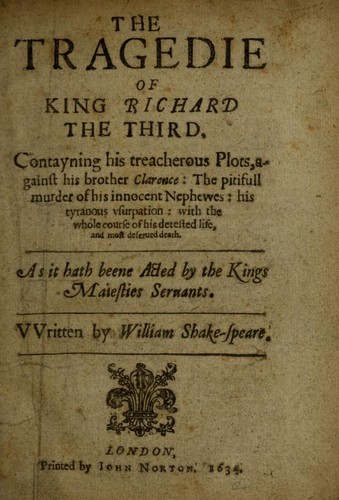
Richard III
William Shakespeare · 1564–1616 · England
Why it matters
A hunchbacked schemer confides directly in the audience while murdering his way to the throne, turning atrocity into shared entertainment. Shakespeare's first great villain, and the bloody culmination of his early history-play cycle on England tearing itself apart.
At a glance
One of his longest early plays, dense with Wars of the Roses genealogy and political maneuvering.
Deep dive
Shakespeare hands his most murderous character the friendliest relationship with the audience in the whole play, and that intimacy is the actual mechanism of his rise, not just a stylistic flourish around it.
Written for readers who have finished the book. No plot recap, and nothing here is safe to read first.
Themes & symbolism
Richard opens the play alone on stage, confiding his plan to be a villain directly to the audience before he's done anything villainous at all, and that soliloquy sets the pattern for everything that follows: every murder, every seduction, every betrayal is narrated to us in advance by Richard himself, gleefully, as if the play's real relationship isn't between Richard and his victims but between Richard and whoever's watching. Shakespeare uses that intimacy to implicate the audience in a way few of his other tragedies attempt, since laughing along with Richard's asides means actively enjoying the same cruelty the rest of the court is too slow, too trusting, or too compromised to stop.
The play closes out the first history tetralogy's long account of England tearing itself apart in the Wars of the Roses, and Richard functions as that cycle's grim summation: a state that has already normalized deposition, betrayal, and casual violence among its ruling family produces, almost inevitably, a figure skilled enough to exploit every one of those normalized habits for his own advancement. Richard's physical deformity, which he names constantly as his motive and his excuse, is less a cause of his cruelty than a story he tells about himself and lets the audience half believe, a self-justifying myth performed with the same theatrical relish he brings to everything else.
The Wooing of Anne as a Test of the Audience, Not Just of Her
Richard's seduction of Lady Anne over her father-in-law's coffin, a man Richard himself killed, is often staged as the play's most audacious set piece precisely because it's aimed less at persuading Anne than at proving to the audience what Richard is capable of talking anyone into. He tells us beforehand he expects to win her and predicts he won't keep her long, treating the entire courtship as a demonstration of technique rather than genuine desire, and her eventual consent functions less as a comment on her weakness than as Shakespeare's proof that rhetoric untethered from any real feeling can overpower grief itself.
The last seal: what actually happens, and why it lands the way it does.
The ending, explained
Richard's confidence finally cracks the night before Bosworth Field, when the ghosts of everyone he's murdered process through his dream cursing him one by one, the first moment in the play where his usual command of language deserts him and he's left, alone again but without an audience to perform for, genuinely afraid of himself. On the battlefield the next day he loses his horse and, in the play's most quoted line, offers his kingdom for another one, a small, almost absurd deflation of a man who has spent five acts treating power as something to be seized by wit rather than something that could simply be taken back by force. Richmond, the future Henry VII, kills him and closes the play with a marriage promise meant to unite the warring houses at last, ending the tetralogy on an order Shakespeare's own audience, living under Richmond's granddaughter, would have understood as the peace their own dynasty was founded on.
Where to go next
 William Shakespeare · 1595Romeo and JulietLvl 4Fast paced
 William Shakespeare · 1596A Midsummer Night's DreamLvl 3Fast paced
 William Shakespeare · 1601HamletLvl 6Medium pace
 William Shakespeare · 1602Twelfth NightLvl 4Fast paced
 William Shakespeare · 1603OthelloLvl 6Fast paced
 William Shakespeare · 1606King LearLvl 7Medium pace