
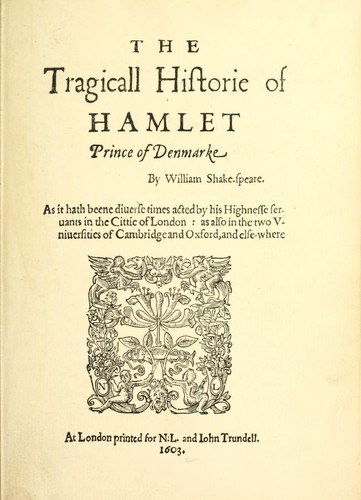
Hamlet
William Shakespeare · 1564–1616 · England
Why it matters
A ghost demands revenge; a prince spends five acts thinking about it. The old blood-revenge plot slowed down around a consciousness so full it changed what characters in fiction could be: the most quoted, performed, and argued-over play in the language.
At a glance
Dense wordplay and long soliloquies, but the most annotated text in English eases the way.
Deep dive
Why the prince who thinks the most gets blamed for delay, when the play is actually asking whether decisive action was ever the right response to what he's been told.
Written for readers who have finished the book. No plot recap, and nothing here is safe to read first.
Themes & symbolism
Hamlet is a play about the impossibility of getting clean information inside a court built on surveillance: everyone is watching everyone, Polonius stages conversations to eavesdrop on his own children, Claudius and Gertrude summon Rosencrantz and Guildenstern to spy on their friend, and Hamlet answers by staging his own performance, feigning madness precisely so the court will read his real observations as noise. The play-within-the-play he stages to test Claudius isn't a detour from the plot — it's Hamlet solving, in the only way available to him, the problem of how you verify a ghost's accusation in a world with no reliable witnesses, and Claudius's visible reaction is the closest thing to proof the play ever grants either Hamlet or the audience.
The famous delay is usually framed as a character flaw, but the soliloquies make the more interesting case that decisive action was never obviously correct here — the to be or not to be speech isn't about killing Claudius at all, it's about whether existing itself is worth the cost, and the graveyard scene's extended meditation over Yorick's skull generalizes that doubt from Hamlet's personal situation to the fact of death itself, indifferent to rank or wit. Read this way, Hamlet's hesitation isn't a defect the plot needs him to overcome so much as the play's actual subject: what it looks like to be a mind capacious enough to hold every angle of a problem at once, in a situation that keeps demanding a single, irreversible action.
Collateral damage
Ophelia is destroyed by a plot that isn't really about her at all — used by her own father and the king to test Hamlet, then abandoned by Hamlet himself once he suspects, rightly, that she's being deployed against him, she has none of the interiority the play grants Hamlet in his soliloquies, and her descent into madness and death by drowning is left genuinely ambiguous between accident and suicide precisely because no one in the play, including the gravediggers debating her burial rites, can agree on how to read her. Her death, alongside Polonius's accidental killing, is where the play makes its clearest case that a single crime at the top of a state doesn't stay contained at the top: Claudius's usurpation radiates outward and costs lives that had no part in the original wrong.
The last seal: what actually happens, and why it lands the way it does.
The ending, explained
The fencing match Claudius engineers has two redundant methods of killing Hamlet — Laertes's blade poisoned at the tip, and a poisoned cup held in reserve — and both go wrong in ways Claudius didn't plan: Gertrude drinks the poisoned wine herself, and the blade changes hands mid-bout, wounding both Laertes and Hamlet. Laertes's dying confession finally hands Hamlet the outward proof he's spent the whole play unable to obtain, and Hamlet kills Claudius only in this last, improvised window, achieving the revenge the ghost demanded in nearly the same breath as his own death. His final request to Horatio — to live on and tell his story straight, rather than die alongside him — is the play's last word on how badly a true account matters in a world that's spent five acts full of performance and misdirection. Fortinbras's arrival to claim an emptied throne closes the play on succession restored from entirely outside the family that destroyed itself.
Where to go next
 William Shakespeare · 1593Richard IIILvl 6Fast paced
 William Shakespeare · 1595Romeo and JulietLvl 4Fast paced
 William Shakespeare · 1596A Midsummer Night's DreamLvl 3Fast paced
 William Shakespeare · 1602Twelfth NightLvl 4Fast paced
 William Shakespeare · 1603OthelloLvl 6Fast paced
 William Shakespeare · 1606King LearLvl 7Medium pace