
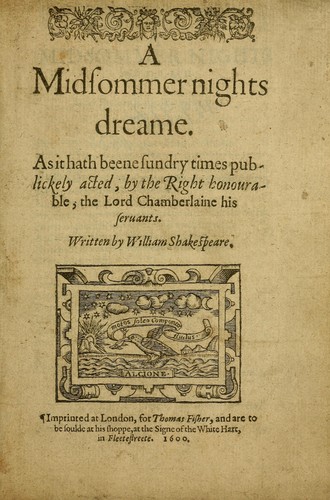
A Midsummer Night's Dream
William Shakespeare · 1564–1616 · England
Why it matters
Four lovers flee Athens into a wood ruled by squabbling fairies, a mischievous sprite, and a flower whose juice makes desire arbitrary. Shakespeare's most purely enchanted comedy treats love itself as a kind of collective dream, one the sleepers can barely explain when they wake.
At a glance
Short, playful, and plotted like a fairy tale; the lightest entry point into the plays.
Deep dive
A flower's juice makes desire completely arbitrary for one night in an enchanted wood, and Shakespeare uses that arbitrariness to ask an uncomfortable question about how reliable anyone's daylight feelings actually are.
Written for readers who have finished the book. No plot recap, and nothing here is safe to read first.
Themes & symbolism
Oberon's love-in-idleness flower, squeezed onto sleeping eyelids to make its victim fall instantly for whoever they see on waking, is less a fairy-tale device than the play's whole argument made literal: Shakespeare keeps insisting, through Lysander's abrupt switch from Hermia to Helena and back again, that romantic passion in daylight isn't obviously more rational or more chosen than passion manufactured by magic overnight. The lovers wake from the wood convinced their feelings have simply resolved themselves correctly, but the play has just spent four acts showing how easily those same feelings could have resolved the other way, arbitrary in exactly the same proportion whether a flower or an unexamined impulse is doing the choosing.
The mechanicals' clumsy rehearsal and performance of Pyramus and Thisbe, staged for the newly married couples as comic entertainment, doubles the wood's dream logic in a different key: a group of amateur actors take a tragedy of thwarted love completely seriously while producing something the onstage audience can only receive as farce, and Shakespeare lets that gap stand as its own commentary on how unstable the line is between a story that moves you and one that makes you laugh, depending entirely on who's telling it and who's watching.
Titania and Bottom as the Wood's Most Honest Couple
Titania, drugged into infatuation with Bottom the weaver while he's wearing a donkey's head, produces the play's strangest and, in its way, most tender relationship: she showers him with genuine devotion, and he accepts it with an unbothered, almost regal calm entirely unbothered by his own transformation, treating fairy attendants and midnight serenades as simply his due. Shakespeare never plays the pairing purely for cruelty; there's real sweetness in how completely unembarrassed Bottom is by circumstances that would mortify anyone else, which makes their sudden separation, once Oberon lifts the spell, feel less like a punchline than like the play's clearest demonstration of how much of desire has nothing to do with what its object actually is.
The last seal: what actually happens, and why it lands the way it does.
The ending, explained
Puck corrects his earlier mistake, sorting the lovers back into their proper pairs, Hermia with Lysander and Helena with the now-uncharmed Demetrius, though Demetrius's affection for Helena is left running on the flower's magic even after everyone else's has worn off, a small, easily missed asymmetry the play never resolves and doesn't seem troubled by. Theseus overrules Egeus's earlier objection and folds all three couples into a single triple wedding, and the mechanicals' gloriously inept Pyramus and Thisbe closes the night's festivities as comic relief that quietly rhymes with the tragedy the lovers narrowly avoided. Puck's final address to the audience, offering the whole play back as nothing more than a dream if it's offended anyone, is the last turn of the wood's own logic: even the resolution is offered as something you're free to decide wasn't quite real.
Where to go next
 William Shakespeare · 1593Richard IIILvl 6Fast paced
 William Shakespeare · 1595Romeo and JulietLvl 4Fast paced
 William Shakespeare · 1601HamletLvl 6Medium pace
 William Shakespeare · 1602Twelfth NightLvl 4Fast paced
 William Shakespeare · 1603OthelloLvl 6Fast paced
 William Shakespeare · 1606King LearLvl 7Medium pace