
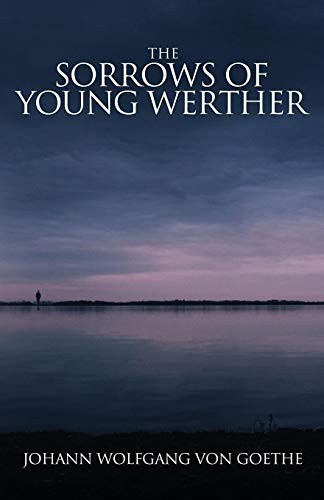
The Sorrows of Young Werther
Johann Wolfgang von Goethe · 1749–1832 · Germany
Originally Die Leiden des jungen Werther (German)
Why it matters
The book that ignited European Romanticism: an artist's letters chart a hopeless love spiraling past anything friendship or reason can talk him back from. Young men dressed like Werther, some died like him: the first literary phenomenon of feeling, and still its sharpest study.
At a glance
Short, emotionally direct letters; difficulty is tonal rather than structural.
Deep dive
Why Werther's reading list — from Homer's clarity to Ossian's doom-laden mist — tracks his unraveling like a thermometer, letter by letter.
Written for readers who have finished the book. No plot recap, and nothing here is safe to read first.
Themes & symbolism
Goethe's epistolary form gives Werther no adjudicating narrator until an editor's brief, clinical interjections near the very end — for most of the book we get only his spiraling logic, unanswered and unchecked, which is exactly what makes his self-destruction feel inevitable rather than diagnosed. The famous shift in his reading, from the ordered clarity of Homer early on to the misty, doom-laden verses of Ossian later, tracks his decline like a thermometer: what a man reads for pleasure becomes, in this novel, a direct readout of what's left of his sanity.
Nature mirrors him relentlessly — the rapturous spring landscapes of the opening letters curdle into storms and desolation as the book proceeds — while Lotte herself is less a woman he wants than an impossible ideal of ordinary domestic happiness he can only ever watch from outside, since she's already married to the steady, decent Albert. Werther doesn't want to steal her so much as worship an access to normal contentment he's constitutionally unable to have himself; the love triangle is really a triangle between Werther, an unreachable ordinary life, and his own excess of feeling.
Albert is the novel's quiet rebuke to Werther's whole worldview: reasonable, employed, capable of loving Lotte without dissolving into her, he represents the bourgeois equilibrium Goethe himself would spend the rest of his long life practicing while Werther's brand of unmediated feeling burned out fast and young. Goethe wrote the book at twenty-four in a matter of weeks, drawing on his own unrequited love for an engaged woman and a friend's real suicide by borrowed pistol, then spent decades afterward faintly embarrassed by how completely the character had eclipsed everything else he wrote.
The Werther Effect
The novel triggered literature's first true wave of imitation: young men across Europe adopted Werther's blue coat and yellow waistcoat as a uniform, and a rash of copycat suicides, some staged with the book left open on the desk, was widely attributed to it. Several German states and Denmark restricted or banned it. The phenomenon left a permanent mark on the language — 'the Werther effect' is still the term sociologists use for suicide contagion following high-profile coverage, two and a half centuries later.
A Genteel Suicide
Werther requests the pistols from Albert himself, under the pretense of borrowing them for a journey, so his rival unknowingly supplies the weapon of his own defeat. Lessing's tragedy Emilia Galotti — about a father who kills his own daughter to spare her dishonor — sits open on his desk at the end, a last curated reference. Even his death is composed with the same literary self-consciousness that shaped every letter before it, a final performance for an audience of one.
The last seal: what actually happens, and why it lands the way it does.
The ending, explained
On Christmas Eve, Werther forces an embrace on Lotte that horrifies her and ends their meetings for good. He sends his servant to Albert asking to borrow pistols for a 'journey,' and Lotte, sensing but not stopping it, hands them over herself. Werther shoots himself that night and lingers, dying, until the following morning. Because suicide was considered a mortal sin, no clergyman attends the funeral, and workmen carry his coffin without ceremony — a deliberately unconsecrated close to a book that spent hundreds of pages making his feeling seem sacred.
Where to go next
 Johann Wolfgang von Goethe · 1808FaustLvl 8Slow burn
 Johann Wolfgang von Goethe · 1809Elective AffinitiesLvl 6Slow burn
 Heinrich von Kleist · 1810Michael KohlhaasLvl 6Fast paced
 Mary Shelley · 1818FrankensteinLvl 4Medium pace
 Walter Scott · 1814WaverleyLvl 6Medium pace
 Thomas Mann · 1912Death in VeniceLvl 6Slow burn