
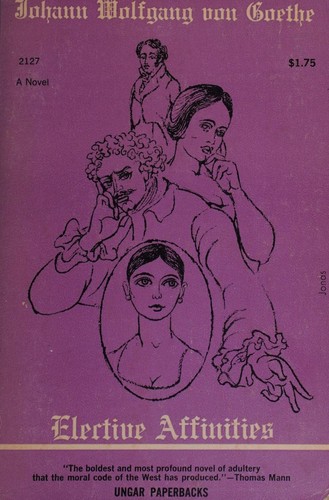
Elective Affinities
Johann Wolfgang von Goethe · 1749–1832 · Germany
Originally Die Wahlverwandtschaften (German)
Why it matters
Two couples recombine like chemical elements in Goethe's coolest, strangest novel: desire treated as a law of nature. A favorite of Benjamin and the modernists, it reads more contemporary than almost anything from its century.
At a glance
Cool, aphoristic prose treating human passion with clinical, scientific detachment.
Deep dive
Goethe describes a settled couple's slow drift toward two other people using the vocabulary of eighteenth-century chemistry, and the coolness of that language is exactly what makes the outcome so hard to watch.
Written for readers who have finished the book. No plot recap, and nothing here is safe to read first.
Themes & symbolism
Eduard and Charlotte invite the Captain and Charlotte's ward Ottilie into their household, and Goethe frames what follows through the real chemical term of the title, elective affinities, the observed tendency of certain compounds to break existing bonds and recombine with a more compatible substance when a third element is introduced. The metaphor isn't decorative; it's the novel's actual method of narration, a cool, clinical register that describes Eduard's growing devotion to Ottilie and Charlotte's to the Captain as something closer to a natural law working itself out than as moral failure, which is exactly what makes the eventual catastrophe so unsettling: Goethe refuses to let the reader simply blame anyone for succumbing to a process he's spent the whole novel describing as inevitable.
The novel's most uncanny scene makes that determinism literal: Eduard and Charlotte conceive a child on a night when each is secretly imagining their true desired partner, and the infant, when born, resembles the Captain in feature and Ottilie in its eyes rather than either of its actual parents, physical proof of a psychic transference neither parent can openly acknowledge. Goethe lets that eerie detail sit without fully explaining it, daring the reader to decide whether the novel is describing genuine supernatural sympathy or simply the intensity of desire reshaping how these people perceive even their own child, and refusing, in either case, to let anyone in this household claim their choices happened purely inside their own free will.
Walter Benjamin's Case for the Novel's Modernity
Walter Benjamin's long essay on this novel argued that its apparent coldness toward its characters isn't detachment but a deliberate refusal of the moralizing a conventional tragedy of adultery would supply, treating desire as subject to something like natural law rather than as a simple failure of virtue. That reading helped establish the novel's modernist afterlife: writers and critics who found nineteenth-century domestic fiction's moral certainties exhausting kept returning to Goethe's 1809 novel precisely because it refuses to hand down a verdict, describing catastrophe with the same measured tone it uses to describe garden design or geological strata.
The last seal: what actually happens, and why it lands the way it does.
The ending, explained
Distracted by an unexpected reunion with Eduard while rowing the infant Otto across the lake, Ottilie loses her hold on the child and he drowns before she can recover him, an accident that lands on her, given everything the novel has already implied about the child's uncanny parentage, as something closer to a verdict than a mishap. Ottilie responds by refusing food and eventually speech altogether, a slow, deliberate self-starvation that reads as penance rather than despair, and dies before Eduard, arriving too late to stop her, can offer anything to change her mind. Eduard survives her by only a short time before dying of grief himself, and Goethe closes the novel with the two of them buried together at Ottilie's own request, side by side in a shared grave the text describes as a kind of waiting, love finally granted the permanence in death that the elective affinities of the living world never let it keep.
Where to go next
 Johann Wolfgang von Goethe · 1774The Sorrows of Young WertherLvl 3Medium pace
 Johann Wolfgang von Goethe · 1808FaustLvl 8Slow burn
 Heinrich von Kleist · 1810Michael KohlhaasLvl 6Fast paced
 Mary Shelley · 1818FrankensteinLvl 4Medium pace
 Walter Scott · 1814WaverleyLvl 6Medium pace
 Thomas Mann · 1912Death in VeniceLvl 6Slow burn