
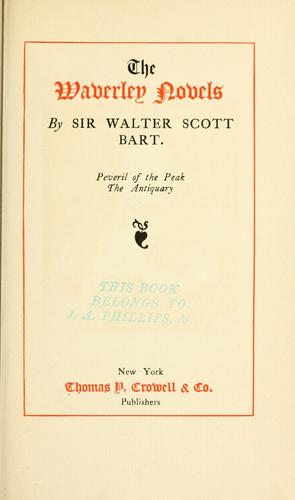
Waverley
Walter Scott · 1771–1832 · Scotland
Why it matters
A dreamy young English officer wanders into the doomed Jacobite rising of 1745 and must choose a side as romance collides with history. The book that invented the historical novel, and the model every one since (from Tolstoy to Hilary Mantel) has answered to.
At a glance
Scots dialect, footnoted history, and a leisurely opening test patience before the plot takes hold.
Deep dive
What it costs a young man to fall in love with a cause the way he'd fall in love with a novel, and why Scott keeps the real fighting just offstage.
Written for readers who have finished the book. No plot recap, and nothing here is safe to read first.
Themes & symbolism
Waverley's politics are really his temperament in disguise: he joins the Jacobite rising less because he's weighed the Stuart claim against the Hanoverian one than because Fergus Mac-Ivor's Highland world reads like the romances he's spent his youth absorbing, and Scott is explicit that this is a caution, not an endorsement — a young man conscripted by his own appetite for story before he's conscripted by any army. Flora and Rose function as the two poles of that appetite made into people: Flora is the romance itself, fierce, principled, committed to a doomed cause with her eyes open, while Rose is the practical, domestic alternative Waverley drifts toward once the romance has cost him enough.
Scott's real innovation is technical as much as thematic — inventing the trick of running an invented, ordinary consciousness through real historical upheaval and real historical figures, so that history is experienced at eye level rather than from a monument's plaque. Every historical novelist since, from Tolstoy dropping Pierre into Borodino to Mantel following Cromwell through Henry's court, is working a variation of the same device: the past made legible by giving it a bystander who doesn't yet know how the story ends.
The Waverley Formula
Scott published anonymously and let the books that followed be known simply as "by the author of Waverley," a modesty that didn't stop the format from becoming the era's dominant literary export: a fictional witness of moderate rank, caught between two historical factions, whose romance plot doubles as a temperature check on which way a whole society is leaning. The device proved durable well past its Scottish setting because it solves a real structural problem — how to make vast, impersonal historical change legible through one person's ordinary, fallible choices. Scott wrote the novel almost seventy years after the events it depicts, close enough that Highland culture was already being romanticized and museumified even as the book was mourning its actual defeat, a doubled nostalgia the novel is only partly aware of indulging in.
The last seal: what actually happens, and why it lands the way it does.
The ending, explained
The rising collapses at Culloden, a defeat Scott keeps almost entirely offstage, summarized rather than dramatized, as if the real historical catastrophe is too large for the novel's method to render directly. Fergus is captured and executed, going to his death with the same unbending romantic pride that drove him to rebel in the first place, while Flora, broken by the loss, withdraws into a convent, the romantic alternative extinguished along with the cause it served. Waverley, who was always more swept along than truly committed, is quietly protected from the rising's worst consequences by personal connections and official leniency, and settles into a comfortable marriage with Rose Bradwardine instead of Flora. The novel's irony is deliberate and a little cold: history grinds on and claims the people who meant it, while the dreamer who merely borrowed its costume gets to go home unscathed.
Where to go next
 Ann Radcliffe · 1794The Mysteries of UdolphoLvl 5Slow burn
 Johann Wolfgang von Goethe · 1774The Sorrows of Young WertherLvl 3Medium pace
 Heinrich von Kleist · 1810Michael KohlhaasLvl 6Fast paced
 Mary Shelley · 1818FrankensteinLvl 4Medium pace
 Alessandro Manzoni · 1827The BetrothedLvl 5Medium pace
 William Makepeace Thackeray · 1848Vanity FairLvl 5Medium pace