
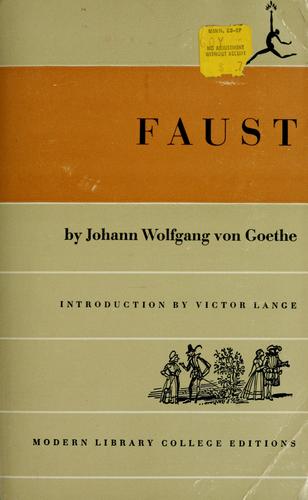
Faust
Johann Wolfgang von Goethe · 1749–1832 · Germany
Originally Faust (German)
Why it matters
The modern age's central myth: a scholar wagers his soul for total experience. Goethe worked on it for sixty years, and its bargain (knowledge and power at any price) names our condition more precisely every decade.
At a glance
Verse drama dense with philosophical allusion and shifting meters across two parts.
Deep dive
What Faust actually promises Mephistopheles in their famous wager — a bet about restlessness, not simply a soul for power — and why the fine print matters far more than either of them expects.
Written for readers who have finished the book. No plot recap, and nothing here is safe to read first.
Themes & symbolism
The wager with Mephistopheles is deliberately not the crude soul-for-power bargain of the older Faust legend: Faust stakes his soul on never feeling a moment so complete he'd want to stay in it forever, which reframes damnation as a failure of restlessness rather than a specific sin. Mephistopheles describes himself as 'part of that power which eternally wills evil and eternally works good,' and Goethe means it structurally as well as rhetorically — every disaster Mephistopheles engineers, from Gretchen's ruin onward, ends up driving Faust further along a path the play ultimately redeems, which makes Mephistopheles less a tempter than an unwilling instrument of the striving he's trying to extinguish.
Part One's Gretchen tragedy is damnation at human scale and full emotional cost — a seduced, abandoned girl who kills her own infant in despair and is executed, while Faust, distracted by Walpurgisnacht revels, barely manages to reach her cell before the end — and Goethe refuses to let the play's eventual cosmic redemption retroactively erase how devastating and how Faust's fault that ruin actually was. The disproportion between Part One's intimate catastrophe and Part Two's vast allegorical pageantry — Helen of Troy, paper currency, the reclamation of land from the sea — is the play's own argument about scale: individual harm doesn't disappear just because the hero's story eventually widens past it.
Faust's final, most ambitious project — draining coastal marshland to build a free society on reclaimed land — is undercut by Goethe on purpose: to complete it, Faust has the elderly couple Philemon and Baucis forcibly removed from the small plot they refuse to sell, and they die in the process, an echo of the biblical Naboth's vineyard that indicts the same utopian ambition the play is about to reward. Goethe wants both things true at once — the striving is genuinely noble and it still tramples people on the way to its vision — which is what keeps the ending's redemption from reading as simple triumph.
A Play in Two Very Different Halves
Written across roughly sixty years, Part One (1808) is compact, domestic, and emotionally direct, while Part Two (published after Goethe's death in 1832) sprawls into masque, classical myth, economics, and cosmic allegory, with Faust barely resembling the anguished scholar of the opening scenes. Goethe seems to have wanted the disjunction: Part Two isn't a sequel resolving Part One's plot so much as a wholesale change of genre, moving from tragedy to something closer to philosophical pageant, as if the only way to earn Faust's redemption was to leave behind the kind of story capable of properly judging him for Gretchen.
The last seal: what actually happens, and why it lands the way it does.
The ending, explained
Blind and near death, Faust hears the digging he believes is progress on his land-reclamation canal — it is actually Mephistopheles's demons digging his grave — and imagines a future free people living on free soil he has made possible, a vision so complete he utters, in the conditional, the fatal words: were he to say to this moment, stay, you are so fair, he would consent to die. Because the utterance is technically anticipatory rather than a claim about present satisfaction, and because it praises collective future flourishing rather than personal pleasure, Goethe treats the letter of the bet as unfulfilled even as Faust promptly dies. Mephistopheles moves to claim the soul regardless, but angels descend and carry it off, reciting the play's most quoted line — 'whoever strives with all his power, him we can redeem.' In heaven, Gretchen's penitent soul intercedes for Faust's, and the closing chorus attributes the whole ascent to 'the eternal feminine' drawing humanity upward — a resolution that rewards striving itself, sins, casualties, and all.
Where to go next
 Johann Wolfgang von Goethe · 1774The Sorrows of Young WertherLvl 3Medium pace
 Johann Wolfgang von Goethe · 1809Elective AffinitiesLvl 6Slow burn
 Heinrich von Kleist · 1810Michael KohlhaasLvl 6Fast paced
 Mary Shelley · 1818FrankensteinLvl 4Medium pace
 Walter Scott · 1814WaverleyLvl 6Medium pace
 Thomas Mann · 1912Death in VeniceLvl 6Slow burn