
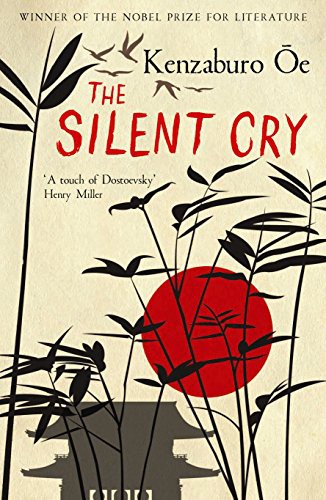
The Silent Cry
Kenzaburō Ōe · 1935–2023 · Japan
Originally Man'en Gannen no Futtobōru (Japanese) · translated by John Bester
Why it matters
Two brothers return to their forest valley, where an 1860 peasant uprising replays in the present. Ōe's densest masterpiece: history, myth, and family guilt in one knot; the Nobel committee singled it out.
At a glance
Interwoven timelines, myth, and dense allusion make this Ōe's most demanding novel.
Deep dive
Two brothers return to their family's mountain village to restage a hundred-year-old uprising, one of them building a myth to live inside and the other slowly finding out how much of it is false.
Written for readers who have finished the book. No plot recap, and nothing here is safe to read first.
Themes & symbolism
Mitsusaburo, hollowed out by his infant son's institutionalization and his wife Natsumi's drinking, follows his younger brother Takashi back to their family's village deep in the Shikoku forest expecting nothing in particular. Takashi arrives with a plan: organize the village youth into a football team, then turn that team into the muscle for a raid on the Korean-run supermarket that locals resentfully call the Emperor's, consciously restaging the peasant uprising their great-grandfather's younger brother is said to have led there in 1860. Takashi needs the reenactment to be true, because his own sense of who he is depends on descending from a man who acted rather than watched. Mitsu, incapable of that kind of belief, mostly watches.
That asymmetry between the brothers, one performing history, the other unable to feel anything strongly enough to perform it, is the novel's real subject, and Oe keeps it literal in Mitsu's own damaged eye and slack passivity, a man whose 'silent cry' names an anguish with no outlet rather than an absence of feeling. Digging through the family storehouse for evidence to support Takashi's version of the uprising, Mitsu instead starts finding an older woman's contradicting testimony, and the myth Takashi has staked his violence and his self-image on starts to come apart in his older brother's hands well before it comes apart for Takashi himself.
A Riot Rehearsed as History
The supermarket raid is never a spontaneous outburst; Takashi drills the football team like a militia and times the looting to fall on the same date, by the old calendar, as the ancestral uprising. Oe uses the Korean ownership of the store to needle at a specific postwar wound, the resentment Japanese communities directed at ethnic Korean shopkeepers who prospered while surrounded by rural poverty, and lets Takashi's youths dress their opportunism in the language of righteous rebellion without ever quite noticing the difference between the two.
What the Storehouse Actually Records
Family legend holds that the great-grandfather's brother died leading the 1860 uprising, a martyrdom Takashi has built his entire self-conception around repeating. The elderly women Mitsu interviews in the village remember it differently, and the documents in the storehouse back them: the ancestor survived, and his survival came at a cost the family myth has spent a century scrubbing out. Mitsu says almost nothing about what he's learned. He doesn't need to; the novel lets the gap between what Takashi believes and what Mitsu now knows do its own quiet work.
The last seal: what actually happens, and why it lands the way it does.
The ending, explained
Takashi's confession, delivered to Mitsu on the night the raid finally collapses into disorder, isn't about the uprising at all: he admits to an old, unresolved violence against their disabled sister that has shadowed his entire adult performance of righteous action. He then kills himself in a manner as ritualized and deliberate as everything else he's staged that year. Mitsu, left holding both the true history of their ancestor and his brother's real confession, doesn't get a redemptive reversal; he gets a slightly steadier version of the same exhausted endurance he started with, a tentative reconciliation with Natsumi, and a job that will take him out of the country. The uprising Takashi needed to be real turns out to be exactly as compromised and human as the century that followed it.
Where to go next
 Kenzaburō Ōe · 1958Nip the Buds, Shoot the KidsLvl 5Fast paced
 Kenzaburō Ōe · 1964A Personal MatterLvl 5Medium pace
 Kenzaburō Ōe · 1983Rouse Up O Young Men of the New Age!Lvl 6Slow burn
 Kenzaburō Ōe · 1990A Quiet LifeLvl 5Slow burn
 Osamu Dazai · 1948No Longer HumanLvl 4Medium pace
 Endō Shūsaku · 1966SilenceLvl 5Slow burn