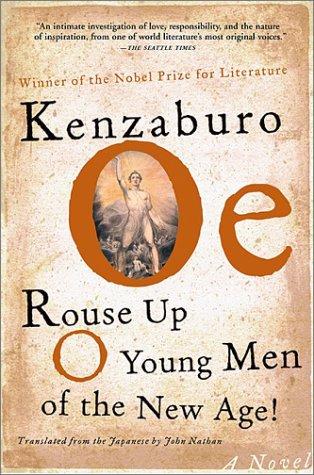
Rouse Up O Young Men of the New Age!
Kenzaburō Ōe · 1935–2023 · Japan
Originally Atarashii Hito yo Mezameyo (Japanese) · translated by John Nathan
Why it matters
A novelist reads Blake aloud to make sense of his disabled son's sudden violence, each chapter titled from a Blake line. Ōe's most directly autobiographical late novel: literature pressed into service as a father's only usable comfort.
At a glance
Interweaves Blake exegesis with domestic narrative, demanding patience with digression.
Deep dive
A novelist rereads William Blake to understand why his brain-damaged teenage son has suddenly grasped, for the first time, that his father will one day die.
Written for readers who have finished the book. No plot recap, and nothing here is safe to read first.
Themes & symbolism
The narrator's son, called Eeyore, has spent his adolescence composing music with a gift no one in the family can fully explain, and the crisis that opens the novel is small and total at once: Eeyore, confronting the idea of his father's mortality for the first time, is undone by it in a way ordinary reassurance can't touch. Ōe's response, rereading William Blake chapter by chapter, each one titled from a line of Blake's own verse, isn't escapism but method: he uses Blake's cosmology of innocence, experience, and imaginative redemption as a working vocabulary for a grief his son has no other language to hold.
Ōe draws the novel's material directly from his own life with his son Hikari, and the book never disguises the autobiography, which raises the stakes of every chapter past what fiction usually risks: this is a father testing, in public, whether literature can actually do anything for a child it wasn't written for. The digressions into Ōe's own wartime childhood and the deaths of friends aren't padding around the Eeyore chapters, they're the same argument run backward, proof that the narrator has always used other people's language, Blake's, his own late friends', to survive what his life alone couldn't process.
Blake's Titles as a Reading Instrument
Each of the novel's seven chapters borrows its heading directly from Blake, and Ōe uses the borrowed line less as decoration than as a lens he hands the reader before the chapter even starts, so that Eeyore's small domestic crises, a tantrum, a swimming lesson, a burst of unexpected composition, arrive already framed by Blake's own preoccupation with innocence surviving contact with a fallen world. The effect is to make Eeyore legible as something closer to a Blakean figure than a case study, a child whose imagination Ōe insists is not diminished by his disability but organized differently, closer in kind to the visionary Blake kept insisting ordinary adults had lost.
The device also protects Ōe from the sentimentality this material could easily collapse into. Because every chapter has to earn its Blake epigraph honestly, the prose keeps testing domestic incident against a much older, stranger body of thought rather than simply reporting on a difficult son with the expected mixture of guilt and tenderness memoir usually settles for.
The last seal: what actually happens, and why it lands the way it does.
The ending, explained
The novel doesn't resolve Eeyore's fear of his father's death so much as relocate it: by the closing chapters, Ōe has stopped trying to talk his son out of the fact and instead built, alongside him, a shared imaginative language, borrowed from Blake, in which mortality is real but not simply terrible. Eeyore's own musical gift becomes the novel's real answer, since a piece he composes late in the book stands as proof that his interior life has processed what no explanation from his father managed to. Ōe ends not on reassurance but on recognition: his son is not a burden he manages but one of Blake's rousing young men of the new age in his own right, however unlikely the world is to see him that way.