
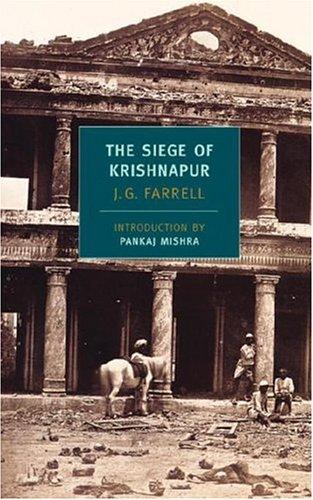
The Siege of Krishnapur
J. G. Farrell · 1935–1979 · England
Why it matters
Besieged in an Indian station during the 1857 uprising, the British defend civilization with phrenology lectures and cannon loaded with silverware. A Booker-winning comedy of Victorian certainties dying under fire: the historical novel as demolition.
At a glance
Urbane period pastiche whose comedy depends on catching the Victorian ideas being skewered.
Deep dive
How a chandelier, a bust of Shakespeare, and an entire Residency library all end up loaded into cannon, and what Farrell's black comedy is really taking aim at.
Written for readers who have finished the book. No plot recap, and nothing here is safe to read first.
Themes & symbolism
Farrell's real subject isn't the 1857 uprising's military detail but the Collector's faith — inherited whole from the Great Exhibition of 1851, which he visited and never got over — that British civilization is a measurable, exportable quantity, stored in objects: a chandelier, busts of Shakespeare and other worthies, table settings, an entire library. As the siege tightens, those objects get literally cannibalized for the fight — melted for shot, stuffed into cannon barrels as makeshift grapeshot, torn apart for barricades — so the British defend 'civilization' by disassembling every material proof of it they own. Farrell plays this for comedy first (a Shakespeare bust fired at attacking sepoys is one of the novel's most quoted images) and then, as starvation and cholera set in, for something closer to horror: progress turns out to have no content beyond the objects that symbolized it, and once those are gone, no argument for British superiority survives contact with the actual siege.
A parallel comedy runs through the sickroom, where the station's two doctors go to war over the cause of the cholera killing the garrison faster than any sepoy attack — one clings to miasma theory and its remedies of bleeding and purging, the other edges toward the still-disreputable idea that the disease is carried and contagious — and Farrell lets neither man be simply right, since the outbreak kills regardless of theory. It's the same joke as the armaments-from-heirlooms gag played straighter: the Victorians in this novel have any amount of confident theory and almost no functioning knowledge, and the gap between the two is where the novel's irony, and its body count, both live.
The Empire Trilogy
Krishnapur is the middle novel of what's now called Farrell's Empire Trilogy, sandwiched between Troubles (the Anglo-Irish War) and The Singapore Grip (the fall of Singapore in 1942), each one picking a different collapse of British imperial confidence and narrating it as tragicomedy rather than tragedy. Farrell's method across all three is the same: burrow into a historical crisis through comic set pieces and physical detail — furniture, food, uniforms, plumbing — until the ordinary stuff of colonial life starts to look as absurd and untenable as the ideology holding it up. Krishnapur won the Booker Prize in 1973, and Farrell was posthumously awarded a 'Lost Booker' in 2010 for Troubles after a 1970 rules gap had left that earlier novel unrecognized in its own time.
Sourced From the Victorians, Aimed at Them
Farrell built the novel's texture from genuine memoirs and siege narratives of the 1857 uprising, lifting period detail and turns of phrase from soldiers' and administrators' own accounts, then redeploying that material against the confidence it was written to project. The effect is a kind of ventriloquism: the novel sounds, sentence by sentence, like the Victorian adventure fiction and imperial memoir it's dismantling, which is exactly what lets the satire land without ever needing to raise its voice.
The last seal: what actually happens, and why it lands the way it does.
The ending, explained
A relief force finally breaks the siege, and survivors who spent months defending 'civilization' with cannon-loaded silverware and the shredded pages of the Residency's library emerge to find the distinction between defenders and the world they were defending nearly erased — starved, filthy, some half-mad, the visible proof of the Collector's Exhibition-era faith having been quite literally fired away over the preceding months. Farrell declines a triumphant note: the relief reads less like vindication than like the last beat of the joke, since the Collector himself ends the novel doubting nearly everything he once took as given about progress, hierarchy, and English destiny. Krishnapur will presumably be rebuilt, restocked with new busts and new silverware, and the whole confident performance will presumably resume — which is the novel's bleakest laugh line.
Where to go next
 Linda Grant · 2000When I Lived in Modern TimesLvl 5Medium pace
 Hilary Mantel · 2009Wolf HallLvl 7Medium pace
 Zadie Smith · 2000White TeethLvl 5Medium pace
 Pat Barker · 1991RegenerationLvl 4Medium pace
 Anthony Burgess · 1962A Clockwork OrangeLvl 7Fast paced
 William Makepeace Thackeray · 1848Vanity FairLvl 5Medium pace