
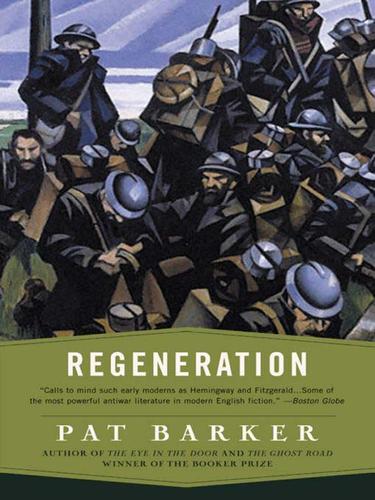
Regeneration
Pat Barker · b. 1943 · England
Why it matters
Shell-shocked officers (including the real poets Siegfried Sassoon and Wilfred Owen) confront psychiatry and the war's insanity at a Scottish military hospital. Barker's meticulous, unsentimental reckoning with World War I trauma.
At a glance
Clear prose, but demands attention to interwoven real historical figures and psychiatric case material.
Deep dive
What it means for a doctor whose job is curing shell-shocked officers well enough to send them back to be killed — and whether treating a war poet's trauma can ever really be separated from silencing his politics.
Written for readers who have finished the book. No plot recap, and nothing here is safe to read first.
Themes & symbolism
Rivers's crisis is structural, not personal: every success he has as a psychiatrist returns a healed officer directly to the trenches, so his talking cure is, functionally, an arm of the war machine he privately doubts. Sassoon sharpens that contradiction into an unbearable point — he isn't shell-shocked at all, he's been committed to Craiglockhart as a face-saving alternative to court-martialing a decorated officer who published a public anti-war declaration, which means Rivers's assignment is really to neutralize a political act by relabeling it a medical one. The novel keeps circling the same question without resolving it: if curing a man means returning him to be killed, and if declaring him sane means silencing his protest, what exactly is the doctor curing him of.
Barker builds the officers' recoveries around the body doing what words can't: Billy Prior, invented but grounded in the era's real class tensions, arrives mute and recovers his voice only alongside a suppressed memory of a friend's death, his hysterical muteness read as the closest thing to protest available to a man without Sassoon's rank or platform. Rivers's own carefully guarded tenderness toward his patients, and hints of a repressed interior life of his own, sit next to the intimacies the war permits between men only under cover of illness — the hospital becomes a rare space where officers are allowed to be frightened, grieving, and openly attached to one another.
Real History, Reconstructed
Sassoon, Owen, and Rivers are historical figures rendered from the documentary record — Sassoon's actual "A Soldier's Declaration" is quoted near-verbatim, and Rivers's real published case studies underpin his methods on the page — while Billy Prior is Barker's invention, a working-class officer who lets the novel examine class friction the real record is thinner on. Sassoon's mentorship of the younger Owen, pushing him away from ornate Georgian verse toward the direct, unflinching diction of poems like "Anthem for Doomed Youth," is dramatized almost as manuscript editing, one poet's technique passed hand to hand into what would become the era's defining war poetry. Barker's meticulousness here sets up the trilogy's next volume, The Ghost Road, to cash in the payoff this book is quietly withholding.
The last seal: what actually happens, and why it lands the way it does.
The ending, explained
Sassoon, worn down less by Rivers's therapy than by loyalty to the men still fighting without him, chooses to return to the front rather than continue his protest from safety — a choice Rivers recognizes as the treatment working exactly as designed, and hates himself for recognizing. It's framed as neither triumph nor failure but the only logical outcome of a successful cure inside a war that has no use for cured men except as soldiers again, leaving Rivers to sit with the fact that his competence and his conscience pull in opposite directions, with no version of his job that resolves the conflict.
Where to go next
 Pat Barker · 1995The Ghost RoadLvl 5Medium pace
 Penelope Lively · 1987Moon TigerLvl 6Medium pace
 Ian McEwan · 2001AtonementLvl 5Medium pace
 Kazuo Ishiguro · 1989The Remains of the DayLvl 5Slow burn
 J. G. Farrell · 1973The Siege of KrishnapurLvl 5Medium pace
 Bapsi Sidhwa · 1991Cracking IndiaLvl 3Medium pace