
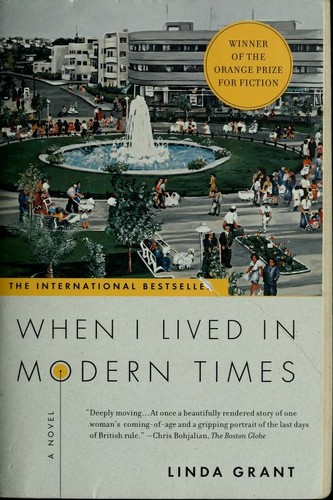
When I Lived in Modern Times
Linda Grant · b. 1951 · England
Why it matters
A young Jewish Londoner sails to 1946 Palestine to reinvent herself on a kibbutz and then in Tel Aviv, drawn unwittingly into espionage as a new state is born. A reinvention story staged against the chaotic birth of Israel.
At a glance
Dense historical and political backdrop asks for some attention alongside a straightforward plot.
Deep dive
A young Jewish Londoner reinvents herself twice over on the way to a new nation being born, and Grant is more interested in what reinvention costs than in which side of the coming conflict she ends up serving.
Written for readers who have finished the book. No plot recap, and nothing here is safe to read first.
Themes & symbolism
Evelyn Sert, a hairdresser's daughter who renames herself Eve on the boat to Palestine in 1946, is drawn by Grant as someone for whom Zionism is inseparable from a more personal hunger: the chance to shed an entire inherited identity, class, accent, even her given name, and build a self from nothing on a kibbutz that promises exactly that kind of erasure and rebirth. The kibbutz's collectivist idealism, communal children's houses, shared labor, deliberate flattening of individual history, offers Eve a version of belonging that has nothing to do with the London she left, and Grant is careful to show both its genuine appeal and its coercive undertow.
Eve's move from the kibbutz to Tel Aviv, a city Grant renders as brand-new, half-built, and defiantly modern in the middle of an ancient landscape, tracks a second reinvention layered on the first: she becomes a hairdresser again, this time by choice rather than inheritance, and builds a circle of friends as improvised and cosmopolitan as the city itself. The novel treats Tel Aviv's architecture, its Bauhaus buildings going up on sand, as a physical embodiment of the same self-authorship Eve is attempting with her own biography.
Her relationship with Johnny, who turns out to be operating under a false identity as a British officer while actually working for the Irgun underground against British rule, complicates Eve's own reinvention by showing her a far more dangerous version of the same instinct: constructing a self for strategic purposes rather than personal freedom. Eve's unwitting role passing him information implicates her in violence she never consciously chose, forcing the novel's argument that a nation being invented from scratch demands the same kind of self-erasure it offers, only with much higher stakes.
Two Evelyns in Conversation
Grant frames the novel with an older Eve looking back on her younger self's arrival, and lets the two voices actually argue rather than simply narrate in sequence, the young Eve impatient with nostalgia and insistent that only the future matters, the older Eve certain that the past is the only thing that ever really counts. That framing device keeps the novel from reading as a simple coming-of-age story; it is explicitly about which self, the one who acts or the one who remembers acting, gets final authority over what a life meant.
The last seal: what actually happens, and why it lands the way it does.
The ending, explained
Once Johnny's double life and Irgun affiliation come to light, Eve is forced to see how completely her information, given in the ordinary course of a relationship, had been used to further violence against the British administration she'd been living alongside, and the romance that had seemed like part of her liberation reveals itself as another kind of manipulation. The novel does not grant Eve a clean political awakening; she remains committed to the new state's existence even as she loses her illusions about the man and the movement that helped bring it into being. The closing exchange between her older and younger selves, arguing about whether the past or the future matters more, refuses to resolve in either direction, leaving Eve's reinvention permanently unfinished rather than completed.
Where to go next
 Alan Hollinghurst · 2004The Line of BeautyLvl 5Slow burn
 J. G. Farrell · 1973The Siege of KrishnapurLvl 5Medium pace
 Bernardine Evaristo · 2019Girl, Woman, OtherLvl 4Fast paced
 Hilary Mantel · 2009Wolf HallLvl 7Medium pace
 Mahasweta Devi · 1974Mother of 1084Lvl 5Medium pace
 Michael Ondaatje · 1992The English PatientLvl 7Slow burn