
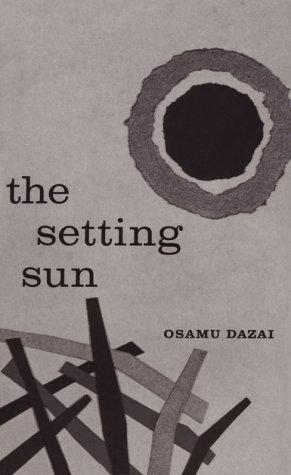
The Setting Sun
Osamu Dazai · 1909–1948 · Japan
Originally Shayō (Japanese) · translated by Donald Keene
Why it matters
An aristocratic family declines into the postwar world: 'people of the setting sun' entered the Japanese language for them. Dazai's elegy for a class, written on the eve of his own end.
At a glance
Confessional and linear, though its bleakness demands emotional stamina.
Deep dive
What Kazuko means by calling her own quiet rebellion a moral revolution, and why Dazai makes her brother's long confessional letters the novel's other engine.
Written for readers who have finished the book. No plot recap, and nothing here is safe to read first.
Themes & symbolism
Kazuko's family, an old aristocratic line stripped of most of its wealth by postwar land reform and taxation, retreats from Tokyo to a small mountain house, and Dazai stages the family's material decline as the literal end of an entire class: Kazuko's mother, described as the last person capable of eating soup with real elegance, embodies a grace that has no further use in the world Kazuko now has to survive in, farming vegetables she was never raised to grow.
Naoji, Kazuko's morphine-addicted brother, supplies the novel's other major voice through diary entries and letters reproduced at length, and his self-loathing account of the same collapse reads as Kazuko's opposite response to identical material: where she is groping toward reinvention, he is dissolving, and Dazai lets both readings sit side by side rather than favoring one. The narrator's own phrase for herself and Naoji, 'victims of a transitional period of morality,' names the novel's real subject: not poverty itself, but the vertigo of inheriting no rules for how to live once the old ones have stopped applying and no new ones have arrived to replace them.
Kazuko's pursuit of Uehara, a dissolute, married novelist she has idolized since glimpsing his photograph as a girl, is deliberately not romantic in any conventional sense. She wants a child by him specifically as an authored act, proof that she can generate a new moral order for herself rather than simply inherit the collapsing one she was born into, and Dazai is careful to make this project cost her Uehara's affection almost entirely, since what she's really courting is the child, not the man.
The Aristocracy Japan No Longer Needed
Postwar land reform and the new constitution's abolition of the peerage genuinely did dismantle Japan's old aristocratic class within a few years, and Dazai, who came from a wealthy landowning family himself and spent his career fascinated by decline and self-destruction, wrote The Setting Sun the year before his own suicide by drowning with a lover in 1948. The title's imagery, an old Japan setting like the sun over Kazuko's mother's generation, is deliberately answered by Kazuko's own closing claim to represent a new dawn rather than an ending, even as her creator's biography suggests he found that claim harder to believe than his narrator does.
The last seal: what actually happens, and why it lands the way it does.
The ending, explained
Naoji leaves behind a long suicide note before killing himself, confessing an unrequited, guilt-ridden love for a married painter's wife and exhaustion with a self he never respected, a confession structurally set against Kazuko's own project rather than simply preceding it. Kazuko, now pregnant by Uehara, who shows little further interest in her, declares in her final letter to him that she intends to raise the child alone as the completed act of her own moral revolution, naming her unborn son a small, willingly chosen victim rather than a tragedy. The novel closes on her defiance rather than her grief, asking the reader to weigh whether her chosen victimhood is more honest, or simply more survivable, than her brother's.
Where to go next
 Osamu Dazai · 1948No Longer HumanLvl 4Medium pace
 Ryūnosuke Akutagawa · 1915Rashōmon and Other StoriesLvl 5Fast paced
 Kenzaburō Ōe · 1964A Personal MatterLvl 5Medium pace
 Yukio Mishima · 1956The Temple of the Golden PavilionLvl 6Slow burn
 Yasunari Kawabata · 1947Snow CountryLvl 5Slow burn
 Natsume Sōseki · 1914KokoroLvl 4Medium pace