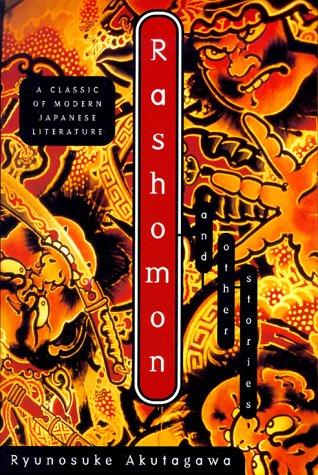
Rashōmon and Other Stories
Ryūnosuke Akutagawa · 1892–1927 · Japan
Originally Rashōmon and Other Stories (Japanese) · translated by Takashi Kojima
Why it matters
'In a Grove' gives one crime four irreconcilable testimonies: the story behind Kurosawa's Rashōmon and the shorthand 'Rashōmon effect.' Akutagawa's jewel-cut tales made moral vertigo a Japanese specialty.
At a glance
Compressed, multi-perspectival narration demands attention despite short length.
Deep dive
Four witnesses, one dead samurai, and no agreement at all about what happened in the bamboo grove, plus the gatehouse where Akutagawa first worked out that self-interest can sound exactly like reasoning.
Written for readers who have finished the book. No plot recap, and nothing here is safe to read first.
Themes & symbolism
In a Grove stages a single violent death, a samurai found dead in a bamboo grove, through four irreconcilable first-person confessions: the bandit Tajomaru boasts of killing him in a fair duel after raping his wife; the wife gives a version built around shame and a plea to be killed herself; the dead man's own spirit, summoned through a medium, insists he took his own life; and a woodcutter, questioned last and least willingly, offers a more prosaic account that contradicts all three without managing to be fully trustworthy either, since he admits only belatedly to stealing something from the scene. Akutagawa refuses to supply a fifth, authoritative version that would settle the matter, and the story's later fame gave English the phrase 'the Rashomon effect' for exactly this kind of self-serving eyewitness contradiction, even though it's the collection's other title story that actually lends its name to the term.
Rashomon itself works the same problem as action instead of testimony. A servant, dismissed and starving beneath Kyoto's ruined main gate during a famine, watches an old woman plucking hair from corpses stored in the gate's tower to sell as wigs. Her self-justification, that the dead woman she's robbing would have done the same to survive, doesn't excuse him so much as license him, and Akutagawa traces the exact moment moral reasoning stops being a private conviction and becomes a transferable tool, handed from the old woman to the servant in a single scene, with no need for four competing confessions to make the contagion visible.
Yam Gruel and the Cruelty of Getting What You Want
A minor, endlessly mocked samurai in the Heian court has exactly one wish, to eat as much yam gruel as he pleases, and when a wealthy patron takes the wish seriously and produces an absurd, overwhelming quantity of it, the man discovers his appetite evaporates the instant scarcity is removed from the equation. Akutagawa's satire here is smaller in scale than the grove or the gate but no less exact: desire in this collection consistently depends on deferral and difficulty to survive contact with its own fulfillment, and a wish granted too completely turns out to be its own quiet punishment.
Kesa and Morito: Two Confessions of the Same Affair
Told through alternating monologues, this story gives Kesa and her lover Morito each their own account of a plot to kill her husband, and each version is shaped as much by vanity and self-justification as by any of In a Grove's testimonies. Kesa, ashamed of her own complicity and unwilling to let her husband die, secretly arranges to take his place in the dark on the appointed night, and Morito, believing himself devoted, unknowingly kills her instead. Paired with In a Grove, the story confirms that the collection's real subject isn't the historical Heian setting or even violence itself, it's the impossibility of ever fully trusting a single person's account of their own motives, including their account of love.