
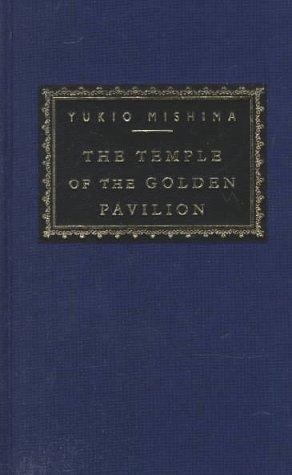
The Temple of the Golden Pavilion
Yukio Mishima · 1925–1970 · Japan
Originally Kinkakuji (Japanese) · translated by Ivan Morris
Why it matters
A stuttering acolyte burns down Kyoto's most beautiful building: drawn from a true case, turned into a philosophy of beauty's unbearability. Mishima's masterpiece, and his own ending forewritten.
At a glance
Dense aesthetic philosophizing woven through a single obsessive consciousness.
Deep dive
A meditation on why beauty, taken seriously enough, starts to look less like a gift than an executioner — and what its narrator's plan to burn down perfection is actually trying to accomplish.
Written for readers who have finished the book. No plot recap, and nothing here is safe to read first.
Themes & symbolism
Mishima builds the novel around a single, escalating heresy: that perfect beauty is not benign. Mizoguchi's stutter and his poverty mean he experiences the Golden Pavilion not as an object to admire but as a rival presence that actively supervises his life, intruding on his one attempt at sex with a woman by superimposing itself, uninvited, between him and her body. Beauty here behaves like jealousy — it wants him to itself, and it punishes his attempts at ordinary human contact by making them feel cheap and unworthy by comparison. The Pavilion's permanence is the crux: because it has survived centuries untouched by the ordinary decay that governs mortal lives, it turns mortality itself into an insult, and Mizoguchi's growing conviction that ugliness, failure, and death are all that's left to him under its shadow becomes, perversely, the only way he can imagine reclaiming a life of his own.
Kashiwagi and Tsurukawa function as the poles Mizoguchi swings between. Tsurukawa's sunniness offers a version of normal, uncomplicated feeling that the novel kills off almost incidentally, removing the one counterweight to Mizoguchi's spiral. Kashiwagi, with his clubbed feet and his theatrical, manipulative seductions, offers the opposite lesson: that visible deformity can be turned into a kind of freedom, a licensed cruelty, precisely because it has already forfeited any claim to conventional beauty. Mizoguchi absorbs this logic and redirects it toward the Pavilion itself — if imperfection can liberate a body, then destroying the one perfect, undying thing in his life might liberate his.
The novel Mishima is said to have pre-written for himself
It's difficult, in retrospect, to read Mizoguchi's arc without Mishima's own ending intruding the way the Pavilion intrudes on his narrator — the author staged a ritual suicide after a failed coup attempt in 1970, and critics have long treated this novel's obsession with beauty, purity, and violent self-erasure as a rehearsal for it. But the comparison should be handled carefully, because the novel itself resists the simplest version of that reading: Mizoguchi does not choose death. His fire is meant, by his own account, to be a shared annihilation with the temple, and it isn't — he lives, and the book's final gesture is toward survival rather than the aestheticized self-destruction its own author would later choose. Whatever Mishima was working out here, the text's own verdict on Mizoguchi's philosophy is more skeptical than reverent: the tyranny of beauty turns out to be escapable, and escaping it looks like wanting a cigarette, not like dying beautifully.
The last seal: what actually happens, and why it lands the way it does.
The ending, explained
Mizoguchi burns the Golden Pavilion down, fulfilling a plan that took years of psychological collapse to arrive at. He had intended to die inside it, closing the loop between his life and the building that had colonized it. Instead, once the fire is set, something in him reverses without warning: he flees to a nearby hillside, watches centuries of accumulated beauty and his own obsession go up in flames, and — in the novel's famous, deliberately anticlimactic final beat — lights a cigarette and simply finds that he wants to live. The destruction of the object doesn't destroy him; it's what finally lets him stop being possessed.
Where to go next
 Yukio Mishima · 1963The Sailor Who Fell from Grace with the SeaLvl 5Fast paced
 Yukio Mishima · 1969Spring SnowLvl 5Medium pace
 Yasunari Kawabata · 1947Snow CountryLvl 5Slow burn
 Jun'ichirō Tanizaki · 1925NaomiLvl 4Fast paced
 Endō Shūsaku · 1966SilenceLvl 5Slow burn
 Kenzaburō Ōe · 1964A Personal MatterLvl 5Medium pace