
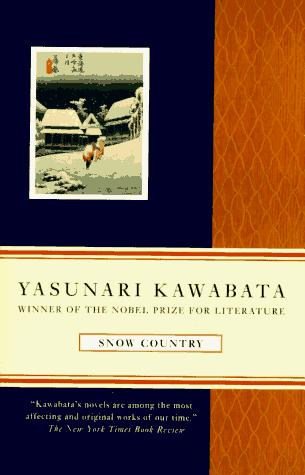
Snow Country
Yasunari Kawabata · 1899–1972 · Japan
Originally Yukiguni (Japanese) · translated by Edward Seidensticker
Why it matters
A Tokyo dilettante and a hot-spring geisha, in a landscape where 'the earth lay white under the night sky.' Prose distilled toward haiku: the book most often handed to readers seeking Japanese literature's essence.
At a glance
Sparse, elliptical, imagistic prose that withholds explicit connective logic.
Deep dive
A love story whose real subject is what happens when a connoisseur turns his eye for beauty on a woman instead of a landscape.
Written for readers who have finished the book. No plot recap, and nothing here is safe to read first.
Themes & symbolism
Shimamura's defining failure is aesthetic consumption. A man who cultivates an expert interest in Western ballet he has deliberately never seen performed live, he prefers representations to realities at a safe remove — and that same preference is exactly what he brings to Komako, whose devotion is inconveniently, wastefully real by his standards. He treats her the way he treats the snow country itself: a place to visit for its beauty, admire intensely, and leave without consequence, never quite registering that a woman's love doesn't hold still and get appreciated the way a landscape does. Yoko receives an even purer version of the same gaze — Shimamura is moved by the beauty of her voice in something close to an impersonal, art-object way, admiring her the way he'd admire a note held a beat too long.
Kawabata's prose method is the argument, not just the style: meaning arrives through composed, juxtaposed images — the famous opening line, 'the earth lay white under the night sky,' Komako's face superimposed on the darkening landscape in a train window — rather than through psychological exposition or explanatory dialogue. That elliptical spareness enacts mono no aware, the pathos of things precisely because they're passing, and it makes the novel's moral critique of Shimamura inseparable from its formal beauty: the same detached, appreciative attention that produces the book's loveliest sentences is the attention that makes him incapable of loving anyone back.
The Train Window Reflection
Early in the novel, Shimamura watches Yoko's reflected face glide across the darkening scenery in a train window, her eye at one point seeming to overlap with a distant mountain light, and the image functions as the book's visual thesis in miniature: a person seen not as a person but as a superimposition on landscape, beautiful precisely because she has been flattened into scenery. Everything Shimamura does to Komako and Yoko across the rest of the novel is a slower version of that same superimposition.
Komako's Diary
Komako keeps a meticulous, disciplined diary and reading log, noting every novel she's finished and every detail of her own life with an earnestness Shimamura can only regard as faintly absurd, a 'wasted effort' by a geisha in a dying hot-spring town with no one to show it to. His condescension toward her self-improvement is the clearest evidence in the book of how little he credits her interior life; she is, to him, a beautifully devoted performer, not a person independently building a self whether or not he's watching. Kawabata never has her diary pay off in any conventional way — it simply sits there as proof of a seriousness Shimamura is constitutionally unable to recognize as real.
The last seal: what actually happens, and why it lands the way it does.
The ending, explained
The novel ends abruptly during a fire at a converted silk-warehouse cinema: Yoko falls, or is dropped, from the burning building's loft, described with the same detached, aestheticized attention Shimamura has given every beautiful and painful image before it. Komako, distraught, carries Yoko's body away while Shimamura simply watches, and the book closes on the Milky Way overhead rather than on any statement of what he feels or does next. Kawabata leaves Yoko's fate genuinely unresolved — this isn't an unfinished draft but the novel's method taken to its logical end: image standing in for emotion, right up to the final line.
Where to go next
 Yasunari Kawabata · 1952Thousand CranesLvl 5Slow burn
 Yasunari Kawabata · 1954The Sound of the MountainLvl 5Slow burn
 Yasunari Kawabata · 1954The Master of GoLvl 5Slow burn
 Yasunari Kawabata · 1965Beauty and SadnessLvl 6Slow burn
 Yukio Mishima · 1956The Temple of the Golden PavilionLvl 6Slow burn
 Jun'ichirō Tanizaki · 1925NaomiLvl 4Fast paced