
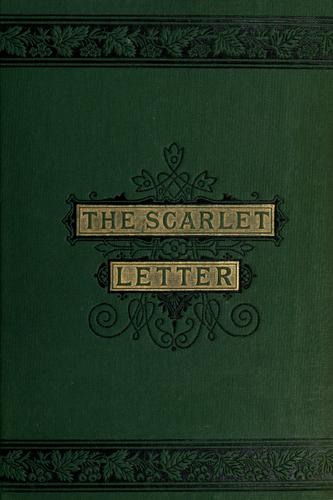
The Scarlet Letter
Nathaniel Hawthorne · 1804–1864 · United States
Why it matters
An adulteress is forced to wear a scarlet 'A' embroidered on her chest in Puritan Boston, while her secret partner's guilt eats him alive in silence. American fiction's founding study of sin, shame, and hypocrisy.
At a glance
Ornate nineteenth-century syntax and heavy symbolic digression.
Deep dive
Why the same scarlet A that brands Hester as 'Adulteress' slowly gets reread by the town as standing for something else entirely — and whose authorship over the letter's meaning the novel is really tracking.
Written for readers who have finished the book. No plot recap, and nothing here is safe to read first.
Themes & symbolism
The letter's shape never changes but its meaning does: the same scarlet A that marks Hester as "Adulteress" is gradually reread by the town as standing for "Able," tracking her years of quiet charity rather than her original sin. That instability is the point — Puritan shame turns out to be a communal performance requiring constant renewal, not a fixed verdict, and Hester's own elaborate gold embroidery of the letter she's forced to wear is a small, defiant act of authorship inside her punishment, converting a brand into a display of skill.
Hawthorne reserves his real severity not for Hester and Dimmesdale's passionate transgression but for Chillingworth's cold, patient one: a husband who conceals his identity to slowly torture the lover who wronged him, feeding on Dimmesdale's private guilt like the "leech" the town takes him for, his very name built from chill. The forest, where Hester and Dimmesdale meet unobserved and where sunlight briefly seems to bless them once the letter comes off, stands against the town's rigid public order as the novel's one pocket of interior freedom — and Pearl functions less as a child than as the letter given a body, an "elf-child" other characters read as a walking symbol, who only becomes fully, humanly present, crying real tears, once Dimmesdale publicly claims her.
The Custom-House: Hawthorne's Own Inherited Guilt
The novel's lengthy autobiographical preface, set in the Salem Custom House where Hawthorne worked a political patronage job he despised, frames the whole story as a rediscovered relic — a moth-eaten scarlet A found in an attic, its history reconstructed from old papers. It's a fiction of authenticity, but also Hawthorne working through real inherited shame: an ancestor, John Hathorne, sat as a judge at the Salem witch trials, and the added "w" in Hawthorne's own name has long been read as a small act of distancing from that lineage. The novel about a Puritan community's public branding of private sin is, underneath its frame, a descendant quietly settling accounts with his own family's history of doing exactly that.
It also lets Hawthorne have it both ways as a narrator. By claiming the story as found document rather than invention, he can pass moral judgment on Puritan Boston's cruelty from a comfortable nineteenth-century remove while still implicating his own bloodline in it — the Custom House's petty, complacent bureaucrats function as a mirror for the same small-mindedness the novel condemns two centuries earlier, just with the theology drained out and the paperwork left standing.
The last seal: what actually happens, and why it lands the way it does.
The ending, explained
Dimmesdale, dying, climbs the scaffold in daylight with Hester and Pearl, publicly confesses his part in Hester's sin, and reveals what the narrative implies is a self-inflicted scarlet mark on his own chest before he dies in Hester's arms. Chillingworth, his revenge suddenly purposeless, withers and dies within the year, leaving his fortune to Pearl. Hester and Pearl leave for Europe, where Pearl is implied to marry well and live happily, freed from her mother's stigma. But Hester eventually returns to Boston alone, resumes wearing the letter without being made to, and spends her remaining years as an unofficial counselor to other women carrying shame and grief — turning a mark forced on her by the town into a vocation she chooses for herself.
Where to go next
 Nathaniel Hawthorne · 1851The House of the Seven GablesLvl 7Slow burn
 Edgar Allan Poe · 1839Selected Tales of Mystery and ImaginationLvl 6Fast paced
 Herman Melville · 1851Moby-DickLvl 8Slow burn
 E. T. A. Hoffmann · 1816The SandmanLvl 6Medium pace
 Harriet Beecher Stowe · 1852Uncle Tom's CabinLvl 4Medium pace
 Ann Radcliffe · 1794The Mysteries of UdolphoLvl 5Slow burn