
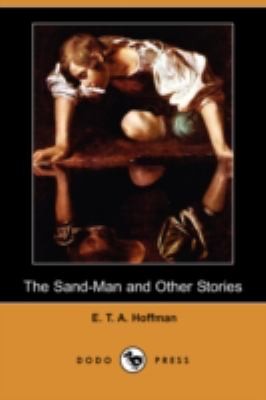
The Sandman
E. T. A. Hoffmann · 1776–1822 · Germany
Originally Der Sandmann (German)
Why it matters
A student's obsession with a beautiful automaton curdles into paranoid delusion, blurring the line between the animate and the mechanical until he can no longer trust his own eyes. Freud used it as his central example in the essay that named 'the uncanny.'
At a glance
Nested narration and ambiguous perspective destabilize what's real.
Deep dive
A student falls obsessively in love with a woman who never seems to say more than a sighed 'Ah, ah!' — and Hoffmann built the story carefully enough that a century later Freud used it to define the uncanny itself.
Written for readers who have finished the book. No plot recap, and nothing here is safe to read first.
Themes & symbolism
Nathanael's childhood terror of the sandman — a nursery bogeyman his nurse claims steals children's eyes, which he comes to associate with the sinister lawyer Coppelius, a visitor complicit in his father's fatal alchemical experiments — establishes eyes and sight as the story's controlling obsession well before the plot's central twist arrives: Nathanael falls in love with Olimpia, the daughter of the professor Spalanzani, precisely for her limpid, unmoving stare, and the reader is invited, long before Nathanael is, to suspect that a beloved whose only conversational contribution is a sighed 'Ah, ah!' might not be entirely what she appears.
The revelation that Olimpia is an automaton, built by Spalanzani with eyes supplied by the optician Coppola — who is all but explicitly the same figure as the childhood-terrorizing Coppelius — doesn't function as a twist so much as confirmation of what the story has been staging all along: Nathanael's 'love' was never responsive to another mind at all, only to his own poetic projection onto a beautifully blank surface, and Hoffmann's cruelest joke is that Nathanael prefers Olimpia's silence to the intelligent, teasing conversation of his actual fiancée Clara, whom he denounces as a 'lifeless automaton' for daring to have opinions about his poetry.
Freud's 1919 essay 'The Uncanny' uses this story as its central case study, arguing that the tale's horror comes not from the fantastical elements themselves but from the return of a repressed, familiar fear (the father, castration anxiety displaced onto stolen eyes) in unfamiliar form — and whether or not one accepts the psychoanalytic reading in full, Freud's instinct that the story's power lies in its irresolvable doubling (is Coppelius supernatural or simply a recurring paranoid delusion? Is Nathanael insane from childhood trauma or genuinely persecuted?) has proven durable: Hoffmann never lets the reader settle the question, and that undecidability is the actual mechanism of the dread.
A Story Told Through Broken Frames
Hoffmann opens the tale with three of Nathanael's letters to Clara's brother Lothar and to Clara herself before abruptly switching to a self-conscious third-person narrator who apologizes to the reader for not knowing quite how to begin the story properly — a nested, self-interrupting structure that keeps drawing attention to its own unreliability as narration rather than smoothing it over. That formal instability mirrors the plot's central question about Nathanael's perception: readers are given his own words, then an outside narrator's frame, then other characters' skeptical commentary on his fears, and Hoffmann never lets any single layer of the telling stand as simply authoritative.
The last seal: what actually happens, and why it lands the way it does.
The ending, explained
Nathanael, having apparently recovered from the breakdown triggered by watching Spalanzani and Coppelius/Coppola violently fight over Olimpia's dismembered, eyeless body, climbs a town tower with Clara to admire the view, when he suddenly produces the telescope-like pocket spyglass Coppola had sold him earlier and, looking through it, relapses instantly and completely — mistaking Clara for Olimpia, trying to throw her from the tower before she's rescued by her brother, and finally spotting Coppelius in the crowd below and leaping to his death shouting about 'beautiful eyes.' The ending refuses any diagnostic clarity: Hoffmann never confirms whether Coppelius/Coppola is genuinely a supernatural persecutor who has stalked Nathanael since childhood or a delusion Nathanael's damaged mind keeps projecting onto an unlucky pair of ordinary men, and the final paragraph's clipped, almost bureaucratic report that Clara later married happily and had children she never had with Nathanael closes the story on a note of chilling normalcy — the world simply absorbs and moves past a death it was never going to be able to explain.
Where to go next
 E. T. A. Hoffmann · 1815The Devil's ElixirsLvl 7Medium pace
 Edgar Allan Poe · 1839Selected Tales of Mystery and ImaginationLvl 6Fast paced
 Heinrich von Kleist · 1810Michael KohlhaasLvl 6Fast paced
 Ann Radcliffe · 1794The Mysteries of UdolphoLvl 5Slow burn
 Johann Wolfgang von Goethe · 1774The Sorrows of Young WertherLvl 3Medium pace
 Horace Walpole · 1764The Castle of OtrantoLvl 3Fast paced