
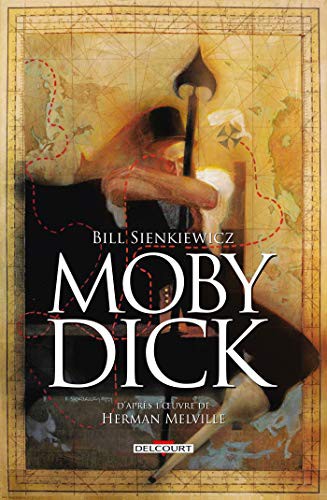
Moby-Dick
Herman Melville · 1819–1891 · USA
Why it matters
A whaling voyage that swells into metaphysics: Ahab against the white whale, with chapters on cetology, rope, and God. It sank Melville's career and now stands as the great American novel's great American rival.
At a glance
Digressive cetology chapters and dense allegorical prose slow even patient readers.
Deep dive
The novel's real subject may be less the whale than the impossibility of ever fully reading one — a question the book poses to itself in its strangest, most digressive chapters.
Written for readers who have finished the book. No plot recap, and nothing here is safe to read first.
Themes & symbolism
The whiteness-of-the-whale chapter is the novel's thesis in miniature: whiteness should mean purity, but Melville catalogs how it also means the shark's belly, the shroud, the albino, the blank page — a color that refuses to settle into one meaning and instead empties out into horror. Moby Dick himself works the same way. He is God, or nature's indifference, or pure malevolent agency, or nothing at all beyond an animal defending itself, and the novel never picks one, because picking one is exactly the mistake Ahab makes. Ahab's monomania is a hermeneutic failure as much as a psychological one: he reads a fixed, personal meaning into a creature that the book insists cannot be fixed, and he subordinates a commercial voyage, a crew, and eventually his own life to that misreading.
The doubloon that Ahab nails to the mast turns this into a formal experiment. Later in the novel, one by one, various crewmen study the coin and each sees something different in its engraved figures — Ahab sees himself, Starbuck sees a warning, Stubb sees a joke, the half-mad cabin boy Pip sees only the world's general meaninglessness — and Melville lets the coin function as a small mirror of the whale itself, an object that returns to each viewer exactly the interpretation he brought to it. The crew's own composition (Nantucket Quakers, Polynesian, African, and Indigenous American harpooners under a New England captain) makes the Pequod a working miniature of a global, multiethnic America, its democratic energy conscripted almost without resistance into one man's private vendetta — a warning about charisma's power to override collective interest that the novel never spells out but keeps circling.
An Encyclopedia Posing as a Novel
The cetology chapters, the anatomy of rope and blubber, the sermon on Jonah, the taxonomy of whale portraiture in art — none of it advances the plot, and that's the point. A book about the limits of knowing a whale enacts those limits formally, piling up genres (treatise, sermon, stage direction, lyric) the way a whale resists being reduced to a single science. The digressions are an argument that totality is unreachable except by accumulation, never by system.
Starbuck's Failure
Starbuck is given every opportunity to stop the catastrophe — he alone sees clearly that Ahab has hijacked the ship's purpose, and at one point stands over the sleeping Ahab with a loaded musket, close enough to end it. He can't do it. His piety and his respect for hierarchy, the very qualities that make him the novel's moral center, are what disarm him, and Melville lets that failure stand as a bleaker verdict than Ahab's madness: reasonable men have a harder time stopping catastrophe than starting it.
The last seal: what actually happens, and why it lands the way it does.
The ending, explained
The three-day chase ends as Fedallah predicted: the Parsee dies first, lashed by harpoon line to Moby Dick's flank, becoming the 'hearse not made by mortal hands' of his own prophecy. Ahab finally plants his harpoon, but the recoiling line loops his neck and drags him overboard to his death as the whale turns and staves in the Pequod itself — the second hearse, built by American hands after all. Every man goes down with the ship except Ishmael, flung clear and kept afloat by Queequeg's coffin, built chapters earlier as a sickbed superstition and repurposed by the narrative as a buoy. He's recovered by the Rachel, a ship still searching the sea for its own lost boy — a quiet allusion to the Biblical Rachel weeping for her children, and the closest thing the novel offers to grace: the sole survivor saved not by the ship that chased the whale but by one still looking for someone to bring home.
Where to go next
 Herman Melville · 1853Bartleby, the ScrivenerLvl 5Medium pace
 Albert Camus · 1942The StrangerLvl 3Medium pace
 William Faulkner · 1930As I Lay DyingLvl 9Medium pace
 Nathaniel Hawthorne · 1850The Scarlet LetterLvl 7Slow burn
 Cormac McCarthy · 1992All the Pretty HorsesLvl 6Medium pace
 Edgar Allan Poe · 1839Selected Tales of Mystery and ImaginationLvl 6Fast paced