
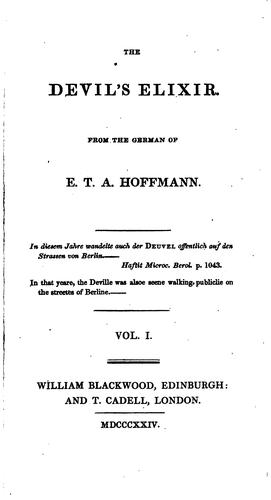
The Devil's Elixirs
E. T. A. Hoffmann · 1776–1822 · Germany
Originally Die Elixiere des Teufels (German)
Why it matters
A monk drinks a forbidden elixir and loses himself to a doppelgänger's crimes across a labyrinthine Gothic plot of identity and damnation. Hoffmann's fullest novel-length descent into Romantic horror.
At a glance
Labyrinthine plot of doubles and nested manuscripts, deliberately disorienting.
Deep dive
Why a monk who drinks a forbidden liqueur keeps getting mistaken for a stranger he's never met, and what a cursed family portrait has to do with it.
Written for readers who have finished the book. No plot recap, and nothing here is safe to read first.
Themes & symbolism
Medardus is a Capuchin monk whose besetting sin, before the novel even starts, is vanity in his own gift for eloquent preaching; when he gains access to a relic kept in his monastery, a flask reputed to be the Devil's own elixir once used to tempt Saint Anthony, curiosity and self-regard together are enough to make him drink it. What follows reads as Hoffmann's answer to the Gothic double: Medardus leaves the monastery under a false identity and is repeatedly mistaken for, and eventually pursued by, Count Victor, a man who looks exactly like him and whose crimes Medardus cannot always be sure he didn't commit himself. Hoffmann never lets the reader settle on whether Victor is a literal double, a hallucination, or evidence that Medardus has simply lost the ability to distinguish his own actions from someone else's.
The doubling is inherited rather than accidental. Medardus eventually learns his family descends from a painter, Francesco, cursed generations earlier for an obsession with painting Saint Rosalia using a model he should never have desired, and that the elixir, the monastery, and Medardus's own uncontrollable passion for Aurelie, who may be his own half-sister, are all threads of the same ancestral sin working itself back out through his body. Hoffmann's Romanticism treats identity as something that can be inherited like a disease, and madness less as an individual failure than as an old family debt finally coming due.
The novel frames Medardus's account as a manuscript discovered and edited by a fellow monk, Brother Spiridion, complete with the editor's own doubts about how much of the narrative to trust, a device Hoffmann uses to keep the reader outside the story looking in at an already-unreliable confession rather than inside Medardus's mind without mediation.
Before Freud Had a Word For It
Hoffmann's doubles predate Freud's essay on the uncanny by over a century, but Freud drew on Hoffmann's fiction directly, elsewhere on 'The Sandman,' to build the concept, and Dostoevsky, an attentive reader of Hoffmann in Russian translation, wrote The Double in 1846 with Medardus's fractured, unreliable sense of his own actions clearly in the background. What Hoffmann isolates here, decades before either writer had the vocabulary for it, is the idea that a self can be haunted less by an external monster than by an alternate version of its own impulses it refuses to acknowledge as its own.
The last seal: what actually happens, and why it lands the way it does.
The ending, explained
Medardus's crimes and his double's crimes converge in Aurelie's death, killed at the altar in the same moment she is taking her vows as a nun, an act neither Medardus nor the narrative ever fully assigns to one man or the other. Broken and disgraced, Medardus returns to his monastery to live out his remaining years as a genuinely humbled penitent rather than the vain preacher he once was, and completes the confession that makes up the novel itself only shortly before his own death, with Brother Spiridion left to finish and publish the account. Hoffmann declines to resolve whether Count Victor was ever a separate person at all, which is the point: the manuscript's last uncertainty is exactly the one Medardus spent the whole book unable to settle about himself.
Where to go next
 E. T. A. Hoffmann · 1816The SandmanLvl 6Medium pace
 Edgar Allan Poe · 1839Selected Tales of Mystery and ImaginationLvl 6Fast paced
 Heinrich von Kleist · 1810Michael KohlhaasLvl 6Fast paced
 Ann Radcliffe · 1794The Mysteries of UdolphoLvl 5Slow burn
 Johann Wolfgang von Goethe · 1774The Sorrows of Young WertherLvl 3Medium pace
 Horace Walpole · 1764The Castle of OtrantoLvl 3Fast paced