
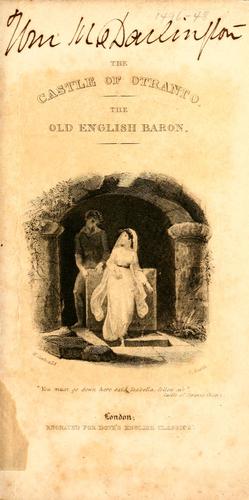
The Castle of Otranto
Horace Walpole · 1717–1797 · England
Why it matters
A giant helmet falls from the sky and crushes an heir on his wedding day, launching a tale of usurpation, sighing portraits, and supernatural dread. The book that invented the Gothic novel in one feverish burst.
At a glance
Short and melodramatic, the founding gothic template rather than a hard read.
Deep dive
A gigantic helmet falls out of the sky, and the entire Gothic novel follows from Walpole taking the absurdity completely seriously.
Written for readers who have finished the book. No plot recap, and nothing here is safe to read first.
Themes & symbolism
Manfred's tyranny over Otranto is founded on an old crime — his grandfather usurped the castle from its rightful line — and Walpole builds the whole plot as a supernatural audit of that theft: the prophecy that 'the castle and lordship of Otranto should pass from the present family, whenever the real owner should be grown too large to inhabit it' is fulfilled with almost mechanical literalism, the giant helmet, then a giant armored leg, then finally the assembled colossal ghost of Alfonso the Good, physically outgrowing and shattering the castle Manfred stole. The supernatural here isn't ambiguous or psychological, as it would become in later Gothic fiction; it's a blunt instrument of restorative justice, punishment scaled to the size of the original sin.
Manfred's response to losing his son Conrad under the fallen helmet is to try to marry the boy's intended bride, Isabella, himself, in order to keep the doomed bloodline going — a decision the novel treats as the real horror of the book, worse than any ghost, because it turns a father's grief into a fresh act of predation within hours of the funeral. Walpole is far more interested in the tyrant's moral collapse than in the ghosts themselves, which function mostly as an external verdict on a corruption that's already fully human and already visible before the supernatural machinery even engages.
Walpole's famous preface to the second edition, admitting the novel was his own invention rather than (as the first edition's fake frame claimed) a translated medieval Italian manuscript, doubles as the book's clearest statement of purpose: he wanted to fuse the 'ancient romance,' with its free rein for imagination and the marvelous, with the 'modern novel,' with its attention to plausible human character, and the resulting hybrid — a tyrant's psychology housed inside a plot of walking portraits and oversized armor — is exactly the template every subsequent Gothic novel, however much more sophisticated, would keep working from.
A Hoax That Founded a Genre
Walpole first published the novel anonymously in December 1764 with an elaborate fictional apparatus — a title page claiming it was 'translated by William Marshal, Gent.' from an Italian original 'found in the library of an ancient Catholic family in the north of England' and printed in Naples in 1529 — a hoax convincing enough that it sold well before Walpole revealed his authorship in the second edition's preface a few months later. The book he built, essentially by accident (Walpole claimed it came to him in a dream about a giant armored hand on a staircase), single-handedly launched the Gothic as a recognized genre, with Ann Radcliffe, Matthew Lewis, and eventually Mary Shelley and Bram Stoker all working, at varying distances, in the tradition this one short, strange, deliberately antiquarian novel began.
The last seal: what actually happens, and why it lands the way it does.
The ending, explained
With Isabella having fled Manfred's advances and taken refuge with the noble peasant Theodore — who is gradually revealed, through a portrait that literally steps out of its frame and other accumulating supernatural signs, to be the true heir of Alfonso the Good — Manfred, in a fit of jealous rage in the dark, mistakes and stabs his own daughter Matilda, believing her to be Isabella meeting Theodore in secret. As Matilda dies, the walls of the castle burst apart and the colossal, fully assembled ghost of Alfonso rises to declare Theodore the rightful prince before ascending to heaven, and Manfred, his usurpation and his last child both destroyed in the same instant, confesses his grandfather's original crime and abdicates. Theodore inherits Otranto but, still grieving Matilda, can only bring himself to marry Isabella — the woman he was drawn to throughout the book — after long, melancholy persuasion, since his heart, the novel's closing line insists, was fixed on Matilda's memory; the restoration of rightful order arrives, pointedly, without anything like uncomplicated happiness attached to it.
Where to go next
 Bram Stoker · 1897DraculaLvl 4Fast paced
 E. T. A. Hoffmann · 1816The SandmanLvl 6Medium pace
 Ann Radcliffe · 1794The Mysteries of UdolphoLvl 5Slow burn
 Johann Wolfgang von Goethe · 1774The Sorrows of Young WertherLvl 3Medium pace
 Nathaniel Hawthorne · 1850The Scarlet LetterLvl 7Slow burn
 Denis Diderot · 1796Jacques the FatalistLvl 6Slow burn