
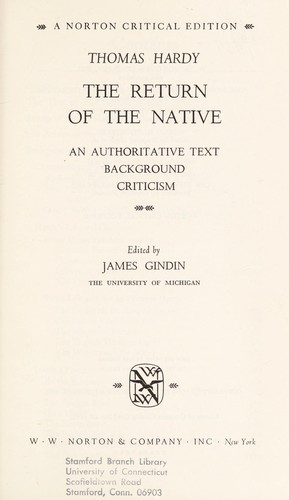
The Return of the Native
Thomas Hardy · 1840–1928 · England
Why it matters
Egdon Heath, vast, ancient, and indifferent, broods over Eustacia Vye's desperate hunger to escape it and the native son who returns to embrace what she can't wait to flee. Hardy's landscape becomes its most fully realized character here, a near-mythic backdrop that outlasts every human plan laid against it.
At a glance
Slow-building and heavily descriptive, with the heath's famous opening chapter testing patience early.
Deep dive
Why Hardy makes an actual stretch of moorland the novel's most decisive character, and what that does to everyone who tries to either love it or escape it.
Written for readers who have finished the book. No plot recap, and nothing here is safe to read first.
Themes & symbolism
Hardy opens the novel with an entire chapter devoted to Egdon Heath before a single named character appears, describing it as ancient, untamable, and essentially unchanged since prehistory, a landscape indifferent to whatever human drama plays out across its surface, and that opening isn't scene-setting so much as a declaration of the novel's real protagonist. Every major character is defined by their relationship to the heath rather than to each other first: Clym Yeobright returns from a glittering career in Paris specifically to live simply among it as a schoolmaster and furze-cutter, while Eustacia Vye, trapped on the heath she despises, dreams obsessively of Paris as the one place capable of matching the scale of her own restless longing, so that the two of them are essentially moving in opposite directions past each other from the moment they meet.
Clym's blindness, brought on by obsessive overwork studying for his teaching plans, operates as the novel's cruelest literalized metaphor: a man who returned to the heath believing he understood exactly what rural, unpretentious life required of him loses his actual eyesight at nearly the same moment his marriage to Eustacia reveals how completely he misjudged what she wanted from their life together, so that his physical blindness and his blindness about his own wife arrive as the same diminishment viewed from two angles.
Diggory Venn, the reddleman whose entire trade of selling sheep dye stains him a permanent, unsettling red from head to foot, moves across the heath as an almost supernatural presence, watching and intervening in the other characters' romantic entanglements from the margins with a persistence none of the more conventionally romantic figures can match; Hardy uses him as proof that the heath rewards patience and adaptation over passion, since Venn alone among the major characters gets an ending that improves rather than diminishes him.
The Heath That Refuses to Be Pastoral
Hardy is careful to strip Egdon Heath of any conventional rural charm, describing it repeatedly as somber, untillable, and essentially useless for the productive farming that gives Hardy's other Wessex novels their agricultural rhythm; nothing here is harvested or improved, which makes it a genuinely different kind of setting from Far from the Madding Crowd's working farmland, a landscape defined by what it refuses to yield to human ambition rather than by what human labor can coax out of it.
The last seal: what actually happens, and why it lands the way it does.
The ending, explained
Eustacia, desperate to leave the heath with her former lover Damon Wildeve after her marriage to Clym collapses under the weight of misunderstanding and his mother's fatal, unwitnessed collapse on the heath itself, drowns in a weir during a storm on the night of their planned escape, and Wildeve, attempting to save her, drowns alongside her, the heath finally claiming both the people who most wanted to leave it. Clym, already blinded and now doubly bereaved, survives into a diminished, penitent old age as an itinerant open-air preacher wandering the same heath he once returned to with such confident purpose, delivering sermons on the very ground that undid his marriage and his sight. Thomasin, Wildeve's abandoned wife, marries the loyal Diggory Venn instead in the novel's one genuinely settled ending, Hardy allowing the heath's one quietly patient character the only happiness the book has left to give out.
Where to go next
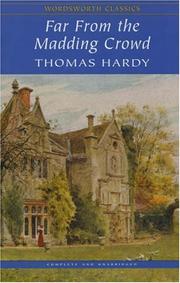 Thomas Hardy · 1874Far from the Madding CrowdLvl 4Medium pace
 Thomas Hardy · 1886The Mayor of CasterbridgeLvl 5Medium pace
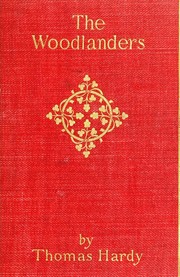 Thomas Hardy · 1887The WoodlandersLvl 5Slow burn
 Thomas Hardy · 1891Tess of the d'UrbervillesLvl 4Medium pace
 Thomas Hardy · 1895Jude the ObscureLvl 5Slow burn
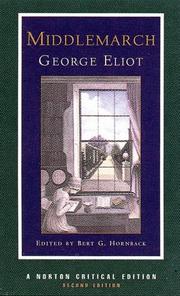 George Eliot · 1872MiddlemarchLvl 6Slow burn