
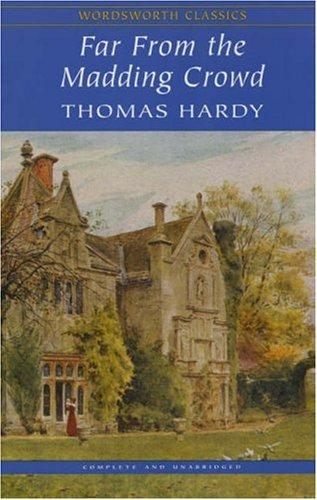
Far from the Madding Crowd
Thomas Hardy · 1840–1928 · England
Why it matters
Independent farmer Bathsheba Everdene juggles three suitors (a soldier, a shepherd, a gentleman farmer) against the rhythms of the agricultural year. Hardy's first Wessex novel, and his most pastoral: the rare Hardy plot that doesn't end in ruin.
At a glance
Hardy's most accessible entry point: vivid rural detail and clear plotting, less bleak than his later work.
Deep dive
Why the storm that saves Bathsheba's harvest says more about who actually deserves her than any of the three proposals stacked up across the novel.
Written for readers who have finished the book. No plot recap, and nothing here is safe to read first.
Themes & symbolism
Bathsheba Everdene inherits a farm and chooses to run it herself rather than hire a bailiff, a decision Hardy treats as genuinely radical for a Victorian woman rather than as a plot convenience, and the novel measures every man who courts her against how he responds to that independence: Gabriel Oak, the shepherd she initially refuses, accepts her authority without resentment and simply keeps working competently at her side regardless of his own feelings, while Farmer Boldwood's obsession curdles specifically because her independence reads to him as a puzzle to be solved rather than a fact to be respected. The valentine Bathsheba sends Boldwood as an idle joke, sealed with the words marry me, sets his fixation running for the rest of the book, and Hardy is precise about the cruelty embedded in even a thoughtless act by someone who has real power over people who take her more seriously than she takes herself.
The storm that threatens to destroy the farm's entire grain harvest becomes the novel's clearest courtship scene without either party treating it as one: while Sergeant Troy's drunken wedding party sleeps off their celebration, Gabriel works alone through the night thatching and covering every rick on the property, and Hardy lets that single act of unglamorous, unrewarded competence say more about who actually deserves Bathsheba than any of the men's declared intentions ever could. Troy's charm, all uniform and swagger, is revealed as functionally worthless the moment real weather or real responsibility intrudes, and the marriage Bathsheba makes in haste becomes the novel's demonstration that attraction and character are frequently measuring two entirely different things.
A Novel Where Skill Is the Real Romantic Language
Hardy structures the courtship almost entirely around agricultural competence rather than conversation: Gabriel's expert lambing and sheep-shearing, Bathsheba's own sharp management of accounts and labor, even Boldwood's initially well-run farm before obsession derails it, and the sheep-shearing supper functions as the novel's real social set piece, a communal celebration of skilled work standing in for the balls and dinners a more conventional Victorian marriage plot would supply instead. Wessex's agricultural calendar, lambing, shearing, harvest, storm, isn't backdrop so much as the actual clock the courtship runs on.
The last seal: what actually happens, and why it lands the way it does.
The ending, explained
Troy is presumed drowned after a swimming accident and returns, unannounced and disguised, years later just as the increasingly deranged Boldwood is finally close to winning Bathsheba's reluctant consent to marry him; Boldwood shoots Troy dead on the spot rather than lose her to a man he thought was gone for good, and is committed rather than executed once the valentine and years of Bathsheba's own unwitting encouragement are entered as evidence of diminished responsibility. Gabriel, who has spent the entire novel working steadily at Bathsheba's side without ever pressing his own claim, nearly leaves the district for a position elsewhere before Bathsheba, finally free of both other men and finally able to recognize what his patience has actually been, asks him to stay. Hardy ends the marriage without any of the earlier suitors' drama, a quiet, working partnership between two people who have already spent years proving, through labor rather than declaration, that they suit each other.
Where to go next
 Thomas Hardy · 1878The Return of the NativeLvl 6Slow burn
 Thomas Hardy · 1886The Mayor of CasterbridgeLvl 5Medium pace
 Thomas Hardy · 1887The WoodlandersLvl 5Slow burn
 Thomas Hardy · 1891Tess of the d'UrbervillesLvl 4Medium pace
 Thomas Hardy · 1895Jude the ObscureLvl 5Slow burn
 George Eliot · 1872MiddlemarchLvl 6Slow burn