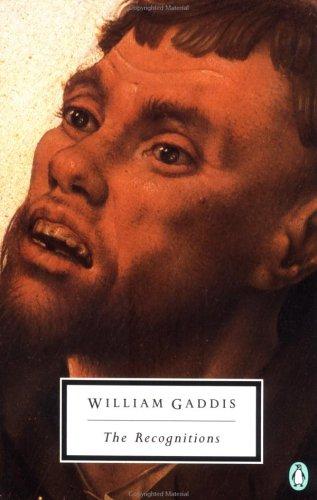
The Recognitions
William Gaddis · 1922–1998 · United States
Why it matters
A forger of Old Master paintings becomes more devoted to his fakes than the art world is to anything genuine, in a sprawling indictment of postwar phoniness. Gaddis's dense, allusive debut, ignored on publication, is now postmodernism's founding American novel.
At a glance
Encyclopedic erudition and a vast cast make this postmodernism's hardest debut.
Deep dive
Why a man who fakes Old Master paintings for a living turns out to be the most honest person in the book.
Written for readers who have finished the book. No plot recap, and nothing here is safe to read first.
Themes & symbolism
Wyatt Gwyon forges Flemish masters with such devotion — studying pigment, craquelure, the exact grain of seventeenth-century technique — that his fakes become more sincere than anything the legitimate art world produces around him, a world Gaddis populates with critics, dealers, and hangers-on who traffic entirely in reputation, gossip, and borrowed taste. The novel's title names its real subject: recognition, in the theological sense of knowing the true self behind an appearance, and in the art-market sense of authenticating a canvas, and Gaddis keeps demonstrating that neither kind is reliably available — the "experts" who authenticate Wyatt's forgeries can't distinguish real devotion from fraud any better than the rest of the cast can distinguish real feeling from performance. Counterfeit currency, counterfeit paintings, counterfeit religious conversion, and counterfeit love braid through hundreds of pages of overlapping New York lives, all orbiting the same question: once craft and sincerity have been separated from the market's ability to price them, what's left to call genuine?
Wyatt's slide through aliases — he goes by Stephen for long stretches, shedding his given name the way he sheds any fixed identity — dramatizes forgery as a spiritual practice as much as a criminal one: to fake a Van Eyck perfectly, you have to annihilate your own hand, become invisible inside someone else's genius, which is either the ultimate humility or the ultimate self-erasure, and Gaddis never lets the reader settle on which. Around him the novel piles up an almost Boschian cast of frauds, deaths, and fires, the postwar New York art scene rendered as a carnival of people performing selves for each other with none of Wyatt's discipline, so that his forgeries, absurdly, come out looking like the only sincere objects in the room.
Ignored, Then Canonized
Gaddis published The Recognitions in 1955 to reviews that ranged from baffled to hostile — its length, its dense allusiveness, and its refusal to hold the reader's hand made it an easy target, and it sold poorly enough that Gaddis spent decades afterward working corporate writing jobs rather than living as a novelist. Its rehabilitation came slowly, through younger writers — William Gass, Jonathan Franzen, David Foster Wallace among them — who identified it as the buried headwaters of American postmodernism, the book that taught a generation how to build a novel entirely out of collage, competing voices, and unresolved irony rather than linear plot. That history mirrors the novel's own plot almost too neatly: a work of ferocious, uncompensated craft, dismissed by the market that was supposed to judge it, recognized as genuine only after enough time had passed for the noise to clear.
The last seal: what actually happens, and why it lands the way it does.
The ending, explained
By the novel's last movement Wyatt has abandoned the forgery trade entirely and traveled to a monastery in Spain, where he takes up work restoring damaged paintings — real, flawed originals rather than fabricated ones — a vocation that lets him use every skill forgery required without the lie underneath it. It's a muted, ambiguous kind of redemption rather than a triumphant one: he's still not producing original work of his own, still working in service of other artists' visions, so the novel leaves open whether restoration is a genuine step toward honesty or just a quieter, more respectable version of the same self-erasure that made him such a gifted forger in the first place. Gaddis stages this against the wreckage of nearly every other character's arc — deaths, ruined marriages, exposed frauds — so that Wyatt's modest exit, choosing craft without deception over craft as deception, reads as the closest thing to grace the book is willing to grant anyone, precisely because it refuses to call it grace outright.