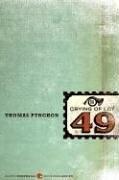
The Crying of Lot 49
Thomas Pynchon · b. 1937 · USA
Why it matters
Oedipa Maas executes a dead lover's estate and finds, perhaps, a centuries-old secret postal system. Paranoia's perfect novella: every clue doubles as coincidence, and the auction gavel never falls.
At a glance
Dense allusion and deliberate narrative undecidability pack a short book tightly.
Deep dive
On the four equally plausible explanations Pynchon refuses to rank, and how the detective-novel scaffolding underneath them all is built specifically to disappoint.
Written for readers who have finished the book. No plot recap, and nothing here is safe to read first.
Themes & symbolism
The muted post horn is nowhere until Oedipa starts looking for it, and then it's everywhere — stamps, graffiti, a lapel pin — which is the novel's whole method in miniature. Every piece of evidence for the Trystero can be read at least four ways: a real underground postal system operating in secret since the Middle Ages, an elaborate practical joke Pierce Inverarity built into his estate as one last posthumous game aimed at Oedipa, a paranoid pattern Oedipa's own mind is imposing on unrelated noise, or some cocktail of all three that can never be sorted into a single truth. Pynchon keeps all four readings simultaneously alive on every page, and that's the point: the novel is less a mystery than a diagram of what paranoia actually feels like from inside, where the thrill and the dread are the same sensation, and any clue can double as proof of order or proof that you're inventing order out of desperation.
Everyone orbiting Oedipa is losing a comparable grip on stable reality at the same moment — her psychiatrist Dr. Hilarius is unraveling under his own wartime guilt, her husband Mucho is dissolving his sense of self through LSD, the variant printings of the play-within-the-novel, The Courier's Tragedy, contradict each other on the very lines that matter most — so that the Trystero mystery reads as one strand in a much wider 1960s fraying of any agreed-upon version of reality. The stamp collection at the center of it all is a fitting emblem: philately is the study of tiny, forged, and misprinted communications, of information that has already started to degrade and multiply past any single authoritative version, which is exactly the condition Oedipa is trying, impossibly, to audit and settle.
Oedipa as Detective, Inverted
Pynchon borrows the private-eye plot's shape — a lone investigator working a dead man's estate, following clues through a corrupt landscape of aerospace companies, cover bands, and shady doctors — but strips out the genre's core promise, an investigator who eventually knows more than the reader and delivers the truth in a final scene. Oedipa never arrives there, and structurally neither can we; the detective-novel scaffolding is present specifically so its collapse can be felt, turning a familiar, reassuring form into the vehicle for its opposite: a story that withholds resolution as a matter of principle rather than incompetence.
The last seal: what actually happens, and why it lands the way it does.
The ending, explained
The title refers to lot 49, a batch of Inverarity's forged Trystero stamps up for private auction, and Oedipa has reasoned her way to a plan: whoever quietly bids on it will reveal whether the Trystero is a functioning secret organization with real members bidding to reclaim its own history, or nothing at all. She takes her seat in the auction room as the "crying" — the auctioneer's chant — begins, and the novel ends there, mid-chant, before lot 49 is called and before any bidder is named. Pynchon cuts to black at the exact instant the mystery could resolve one way or the other, which is the novel's real argument delivered structurally rather than stated: certainty was never actually on offer, only the deferred promise of it, and Oedipa's paranoia — along with the reader's — is left permanently, deliberately unresolved rather than confirmed or debunked.