
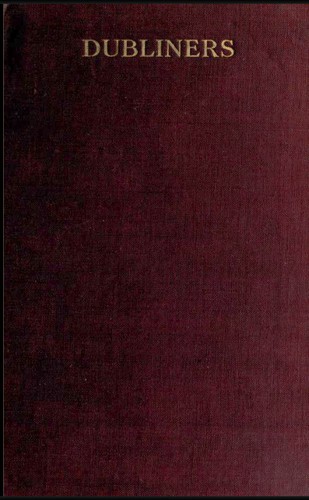
Dubliners
James Joyce · 1882–1941 · Ireland
Why it matters
Fifteen stories of paralysis in Joyce's 'dear dirty Dublin,' each ending in a quiet epiphany, a term he gave to fiction. 'The Dead' is routinely called the finest short story in English. The accessible door into Joyce.
At a glance
Restrained, precise prose; difficulty is in interpreting quiet epiphanies rather than syntax.
Deep dive
Fifteen stories arranged to move from a boy's small failures toward the one adult who finally sees how small his own life has been.
Written for readers who have finished the book. No plot recap, and nothing here is safe to read first.
Themes & symbolism
Joyce called the collection's governing idea "paralysis," and arranged the fifteen stories in four movements he specified himself: childhood, adolescence, mature life, and public life, so that Dubliners reads less as a scattered anthology than as a single argument carried out story by story. Each protagonist reaches a moment of clear sight, what Joyce's own critical vocabulary calls an epiphany, and then fails to act on it: the boy in "Araby" recognizing his infatuation as vanity under the darkened bazaar's dying lights, Eveline frozen at the dock unable to board the boat that would take her away from her father, Little Chandler in "A Little Cloud" glimpsing the writer's life he will never have. The insight arrives on time. The change never does.
Dublin itself is written as a character complicit in the paralysis, its pubs, church interiors, and shabby-genteel parlors rendered with a documentary precision Joyce insisted on to the point of fact-checking street names from exile in Trieste. The city's Catholic and colonial administration both come in for the same scrutiny; corrupt clergy in "Grace," small-time nationalist politics gone cynical in "Ivy Day in the Committee Room," each institution offering its own version of the same lesson, that Dublin trains its people to recognize their own trap and stay in it anyway.
The Dead: A Man Undone By a Song He Didn't Write
"The Dead" closes the collection at far greater length than any other story, and earns it. Gabriel Conroy spends a Christmas party performing competence, a prepared toast, small talk, mild condescension toward his wife Gretta's western Irish background, before Gretta's reaction to an old ballad, "The Lass of Aughrim," unravels the entire evening's performance. She tells him about Michael Furey, a boy who once stood in the rain outside her window in Galway, still in love with her at seventeen, and Gabriel realizes he has never felt anything as total as what she still feels for a boy he never met. The story's famous final image, snow falling equally over the living and the dead across all of Ireland, extends one man's private humiliation into the whole book's argument: paralysis is not a personal failing so much as a national weather system, general and unescapable.
Eveline at the Dock
"Eveline" compresses the entire collection's method into eight pages. Eveline Hill has a ticket, a lover named Frank waiting to take her to Buenos Aires, and every reason to leave a father who drinks and a life spent keeping house for him since her mother's death. Joyce brings her all the way to the gangway before the story simply stops her: she grips the iron railing, and something, duty, fear, the promise she made her dying mother to keep the family together, takes hold and will not let go. Frank calls to her over the noise of the crowd and she does not answer or move. Joyce never explains the paralysis; he stages it as a body refusing an order the mind has already given, which is the collection's clearest single image of what the word actually means.
Where to go next
 James Joyce · 1916A Portrait of the Artist as a Young ManLvl 6Slow burn
 James Joyce · 1922UlyssesLvl 10Slow burn
 James Joyce · 1939Finnegans WakeLvl 10Slow burn
 Virginia Woolf · 1925Mrs DallowayLvl 7Slow burn
 Eyvind Johnson · 1946Return to IthacaLvl 6Medium pace
 Alfred Döblin · 1929Berlin AlexanderplatzLvl 8Slow burn