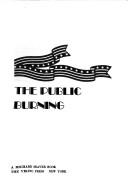
The Public Burning
Robert Coover · 1932–2024 · USA
Why it matters
The real 1953 execution of Julius and Ethel Rosenberg becomes a Times Square carnival, narrated by a fictionalized Richard Nixon and presided over by a folkloric Uncle Sam. Coover's most audacious novel turns Cold War paranoia into hallucinatory indictment.
At a glance
Sprawling, hallucinatory satire mixing real history, invented monologue, and carnival excess across 500-plus pages.
Deep dive
How the real 1953 executions of Julius and Ethel Rosenberg get restaged, in Robert Coover's telling, as a Times Square carnival with Uncle Sam as ringmaster and Richard Nixon narrating half the book himself.
Written for readers who have finished the book. No plot recap, and nothing here is safe to read first.
Themes & symbolism
Coover alternates an omniscient, carnival-barker narration of Cold War America with first-person chapters given over entirely to Richard Nixon, then Eisenhower's vice president, restaging the real execution of Julius and Ethel Rosenberg for atomic espionage as a nationally televised spectacle staged in Times Square, complete with vaudeville routines, cheerleaders, and celebrity walk-ons. The historical record supplies the dates and the verdict; everything else, the carnival apparatus built around them, is Coover's invention, pushed to a pitch that turns Cold War anti-communist hysteria into outright American folklore.
Uncle Sam appears throughout as a genuine mythic entity, not a metaphor but an incarnate national spirit who tests and grooms Nixon as his likely next vessel, and Coover uses that folkloric machinery to argue that the Rosenbergs function less as convicted spies than as a sacrifice the country's anxiety required, fed to a national mythology that needs traitors the way it needs heroes, on a fixed schedule, regardless of the particular facts of any given case.
Nixon's Chapters as Sympathetic Satire
Coover's boldest structural choice is letting Nixon narrate himself with real interiority, ambition, social awkwardness, resentment of the Eastern establishment that looks down on him, so that the same book mocking his opportunism also makes him the most fully human consciousness in it. The effect cuts the satire two ways at once: Nixon is ridiculous, and also the only character granted enough inner life for the reader to recognize an actual person underneath the spectacle.
The Phantom as Uncle Sam's Necessary Enemy
Coover gives Cold War paranoia an actual character, the Phantom, a shape-shifting embodiment of international communism that Uncle Sam needs precisely because a mythology built on righteous defense requires a permanent threat to defend against. The Rosenbergs matter to the novel less as individuals than as evidence Uncle Sam can point to when the Phantom's existence needs proving, a scapegoating mechanism Coover keeps in view throughout the carnival so the reader never loses sight of what the spectacle is actually converting a married couple's execution into. Coover researched the actual trial transcripts and news coverage exhaustively, and the novel keeps quoting them nearly verbatim inside its most fantastical passages, a documentary spine running underneath the folklore that dares the reader to say exactly where the invented material starts.
The last seal: what actually happens, and why it lands the way it does.
The ending, explained
After the execution, Nixon, humiliated and stripped of his dignity in a hotel room by Uncle Sam himself, is subjected to a grotesque, sexually charged initiation staged as both coronation and violation, an anointing rather than a punishment inside the novel's own mythology. Uncle Sam declares himself and Nixon one and the same, marking Nixon as the national spirit's next chosen vessel, and the novel closes with Nixon accepting the role he's spent the book alternately courting and dreading. Coover leaves deliberately unclear whether Nixon has been used or elevated, since in the mythology the book has built across five hundred pages, those turn out to be the same event.