
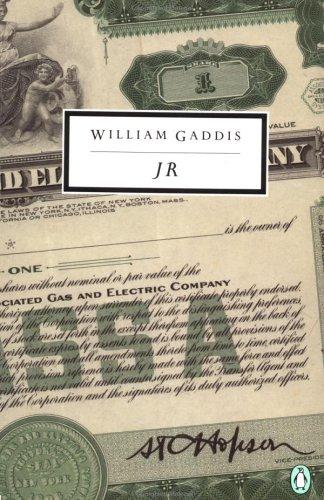
J R
William Gaddis · 1922–1998 · United States
Why it matters
An eleven-year-old boy builds a paper business empire entirely by mail and payphone, exposing American capitalism as a con nobody bothers to notice. Gaddis's dialogue-only satire, told almost without narration, won the National Book Award.
At a glance
Nearly unbroken, unattributed dialogue with no narration to guide the reader.
Deep dive
Six hundred pages of unbroken, unattributed dialogue in which an eleven-year-old outperforms every adult in the room at capitalism — and the novel never once stops to explain the joke.
Written for readers who have finished the book. No plot recap, and nothing here is safe to read first.
Themes & symbolism
Gaddis's foundational move is formal: the novel is composed almost entirely of overlapping, unattributed dialogue — phone calls, interruptions, mishearings — with barely any narration to tell you who's speaking or what just happened. That formlessness is the argument, not a stylistic dare. J R's paper empire, built from a school pay phone out of junk mail, penny stocks, and loopholes designed for people with real capital, succeeds precisely because nobody around him is paying close enough attention to stop it — the same inattention the prose forces onto the reader. Money here is pure noise, a self-perpetuating signal drowning out music, education, and anything else that resists being monetized, and the book's exhausting, headlong style makes that condition audible instead of merely describing it.
Edward Bast, the one character with a genuine artistic vocation, is the novel's real casualty: his ambitions shrink continuously across the book, from opera to symphony to sonata to something closer to a fragment, as J R's ceaseless demands eat the time composition requires. That diminishment tracks Gaddis's long-running obsession, carried over from The Recognitions, with entropy — systems left unattended don't stay neutral, they degrade, and American culture's total absorption into the logic of money is one more instance of the same law. J R himself is the cruelest joke of all: not a genius or a monster, just an ordinary, none-too-bright kid mechanically applying rules absorbed from civics class and afternoon television, and the fact that this is enough to build a conglomerate says everything about how little intelligence the system actually rewards.
A Novel Made of Voices
The unattributed-dialogue technique made J R notorious for difficulty on publication and remains the reason it's more admired than read — there is no narrator to lean on, and identifying speakers is a skill the book demands you build from scratch, chapter by chapter. Gaddis considered this the only honest way to render a culture that talks constantly and listens to almost none of it, and the technique's later influence runs directly through William Gass, David Foster Wallace, and Jonathan Franzen, all of whom cited Gaddis's willingness to make form do the satirical work that plot and commentary usually do instead.
The last seal: what actually happens, and why it lands the way it does.
The ending, explained
By the novel's last stretch, J R's empire attracts exactly the scrutiny it could never survive — SEC and IRS investigators pulling at a structure that was mostly leveraged debt and unanswered phone calls — and it unwinds fast enough to help tip the wider economy into crisis, collateral damage from a scheme run out of a school pay phone. Bast ends the novel physically wrecked, sick with pneumonia in a ruined apartment, his composing ambitions reduced nearly to nothing. The closing phone call is the gut-punch: J R, entirely undaunted by the collapse he's just caused, is already pitching Bast the next scheme. Nothing has been learned; the machine that consumed one artist's years is simply looking for its next input.
Where to go next
 William Gaddis · 1955The RecognitionsLvl 10Slow burn
 William Gaddis · 1994A Frolic of His OwnLvl 8Slow burn
 Donald Barthelme · 1981Sixty StoriesLvl 6Medium pace
 Thomas Pynchon · 1966The Crying of Lot 49Lvl 8Medium pace
 James Joyce · 1914DublinersLvl 3Slow burn
 Robert Coover · 1977The Public BurningLvl 8Slow burn