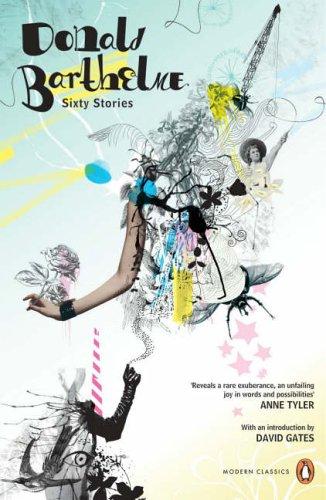
Sixty Stories
Donald Barthelme · 1931–1989 · USA
Why it matters
Three decades of Barthelme's short fiction (fairy tales fractured by corporate jargon, deadpan dialogues, footnoted parodies) assembled into the era's defining case for the short story as collage. The single best entry point into American postmodernism's most purely playful mind.
At a glance
Plotless, collage-built stories that abandon conventional narrative logic reward patience over momentum.
Deep dive
Why a giant balloon over Manhattan, a classroom where the gerbil, the tulips, and the puppy all expire on schedule, and a mock magazine profile of Robert Kennedy are the same writer running the same trick for thirty years.
Written for readers who have finished the book. No plot recap, and nothing here is safe to read first.
Themes & symbolism
Barthelme's method across three decades barely varies: take a familiar form, the magazine profile, the fairy tale, the classroom show-and-tell, and run it through a flattened, deadpan voice until its logic breaks down in public. "The Balloon" inflates a vast, unexplained object over blocks of Manhattan and spends the whole story cataloguing the city's competing interpretations of it, art critics, children, the bureaucrats who want it removed, without ever explaining what it actually is, because the story's real subject is how badly everyone needs an explanation.
"The School" pushes the same deadpan escalation furthest: a teacher recounts, in flat, unbroken sentences, how the classroom's gerbil, snake, tulips, puppy, and eventually two students' parents all die in quick succession, and the children's response, wanting to make love to counteract all the death, lands as both a genuine philosophical position and the funniest line in the book. "Robert Kennedy Saved from Drowning" takes the celebrity profile's clipped, third-person question-and-answer format and applies it to a barely fictionalized RFK, exposing how thin that journalistic form's claim to intimacy actually is.
"Some of Us Had Been Threatening Our Friend Colby" runs the collage instinct at its most absurd: a group of friends debate, in the reasonable tone of a committee meeting, the precise etiquette of hanging Colby for being tiresome, footnoting their deliberations with citations as though procedure could launder the horror out of the premise. Across all sixty stories, corporate and academic jargon keeps leaking into fairy tale and myth until neither register sounds stable, which is Barthelme's whole argument about what decades of institutional language had done to American sentences.
The Balloon as a Machine for Reading Reactions
Nothing about the balloon itself gets explained, its size, its purpose, even who released it stays unstated, because Barthelme is interested only in the interpretive scramble it produces: is it art, a threat, a commercial stunt, therapy for its creator's absent lover. The story ends with the balloon simply deflated and packed away once its purpose, private grief, resolves, and the city's elaborate theories are left looking exactly as arbitrary as they were.
Colby's Hanging by Committee
The friends debating Colby's execution never raise the actual question of whether it's justified, only the etiquette of doing it well: what kind of rope, what kind of gathering, whether a string quartet is appropriate. Barthelme's target is procedural language's capacity to normalize anything it's applied to consistently enough, a joke that reads, decades on, as a rehearsal for exactly the kind of bureaucratized violence the century kept producing.