
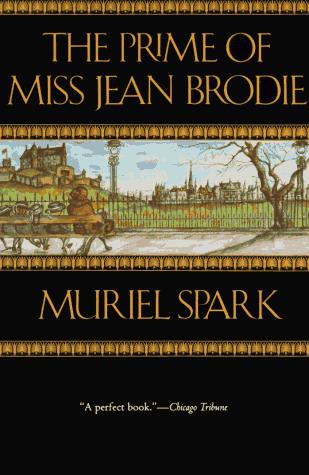
The Prime of Miss Jean Brodie
Muriel Spark · 1918–2006 · Scotland
Why it matters
A charismatic Edinburgh schoolmistress shapes her chosen girls in her own image, flashing forward to the betrayal that ends her. Spark's diamond-hard little novel about influence, fascism, and the danger of being someone's favourite.
At a glance
Deceptively brisk prose with a flash-forward structure that rewards attentive tracking.
Deep dive
Spark tells you on page one, essentially, who betrays Miss Brodie — and spends the rest of the book making the more interesting case for why.
Written for readers who have finished the book. No plot recap, and nothing here is safe to read first.
Themes & symbolism
Spark's flash-forward technique — revealing early and repeatedly, in brief authorial asides, which Brodie girl will 'betray' her, which will die in Spain, which will become a nun — deliberately drains the novel of conventional suspense in order to redirect all its tension toward motive and meaning instead: knowing early that Sandy is 'the one who betrayed Miss Brodie' turns every subsequent scene between them into an exercise in reading backward for the causes of a foregone conclusion, which is exactly the kind of moral archaeology the book wants from its reader.
Miss Brodie's cult of personality over her chosen 'set' — her insistence that she is in her 'prime' and uniquely qualified to shape 'the crème de la crème,' her open admiration for Mussolini and fascist discipline, her manipulation of the girls' romantic and political lives at one remove through proxies like the art teacher Teddy Lloyd — is Spark's precise, chilling argument that charismatic authority over impressionable minds and outright fascism aren't distant analogies but structurally the same thing at different scales; Brodie genuinely believes she's liberating her girls from convention while in fact conscripting them into her own aesthetic and political vanity.
Sandy's motives for betrayal — jealousy over her own affair with Teddy Lloyd (whom she pursues partly, it's suggested, to understand Brodie's own hold over him), horror at Brodie's having steered the impressionable Joyce Emily toward death fighting for Franco in Spain, and a slow-forming recognition that Brodie's self-styled 'prime' was never as generous as it presented itself — are left genuinely mixed rather than resolved to one clean cause, and Sandy's own later transformation into the author of a treatise on 'the transfiguration of the commonplace,' written from behind a convent grille, suggests she spends the rest of her life working out exactly the same question the reader is left with: whether what she did was betrayal, justice, or both at once.
A Novel Told Out of Order on Purpose
Spark's decision to reveal outcomes — Joyce Emily's death, Sandy's betrayal, Brodie's dismissal — well before the scenes that cause them arrive is a rare and disciplined structural choice for a novel this short, and it does real work: rather than building toward a twist, the book builds toward understanding, forcing the reader to hold cause and effect in mind simultaneously the way memory itself does, jumping between a schoolgirl's present and an adult's retrospective knowledge in the same paragraph. The technique also lets Spark's dry, exact comic prose stay light even while circling genuinely dark material — fascism, statutory-adjacent seduction, a teenager's death — because the reader is never waiting anxiously for the other shoe to drop; it's already been named, which frees the book to be as funny as it is disturbing at the same time.
The last seal: what actually happens, and why it lands the way it does.
The ending, explained
Sandy, having grown disturbed by Brodie's continued grooming of impressionable girls for causes not their own — especially the revelation that Brodie encouraged the naive Joyce Emily to run off and fight for Franco, only for Joyce Emily to die when her train is attacked — tells the headmistress, Miss Mackay, that Brodie can be dismissed for promoting fascism, a charge that, unlike the school's earlier, unsuccessful attempts to catch Brodie on more conventional grounds, actually sticks. Brodie is forced out and dies without ever fully learning which girl among her set was responsible, though the novel notes she suspects, wrongly to the end, someone other than Sandy. Sandy herself converts to Catholicism, becomes a cloistered nun, and, when a young interviewer asks what most influenced her famous psychological treatise, can only answer 'there was a Miss Jean Brodie in her prime' — a closing line that refuses to let Sandy, or the reader, settle whether escaping Brodie's influence was ever really possible, since the woman she betrayed remains, visibly, the whole shape of what Sandy became.
Where to go next
 Muriel Spark · 1959Memento MoriLvl 4Fast paced
 Kingsley Amis · 1986The Old DevilsLvl 4Medium pace
 Anthony Burgess · 1962A Clockwork OrangeLvl 7Fast paced
 E. M. Forster · 1924A Passage to IndiaLvl 6Medium pace
 Aldous Huxley · 1932Brave New WorldLvl 4Medium pace
 J. G. Farrell · 1973The Siege of KrishnapurLvl 5Medium pace