
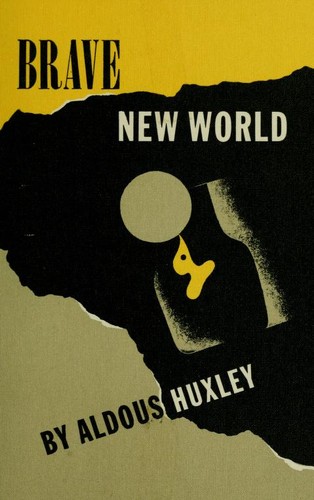
Brave New World
Aldous Huxley · 1894–1963 · England
Why it matters
In a World State that breeds citizens by caste and dissolves discontent with soma and conditioning, a visitor from a reservation exposes what's been engineered out of being human. The century's other great dystopia: happiness enforced instead of terror.
At a glance
Clear, brisk prose; the unease is conceptual and builds cumulatively.
Deep dive
Why Mustapha Mond gets the novel's most persuasive speech, why Bernard Marx's rebellion turns out to be envy in disguise, and why John, raised on Shakespeare instead of hypnopaedia, becomes the one variable the World State can't actually engineer around.
Written for readers who have finished the book. No plot recap, and nothing here is safe to read first.
Themes & symbolism
Huxley's genius is to make the dystopia frictionless: nobody in the World State is lying awake wanting to overthrow it, because the whole apparatus — caste-stratified decanting, hypnopaedic slogans, Pavlovian conditioning against books and nature, and soma standing ready the instant any unpleasant feeling surfaces — has been engineered to make control indistinguishable from contentment. There's no need for a boot on the face when the boot has been bred out of the desire to resist. Soma is the novel's most economical symbol: not a truth serum or a poison but a perfect consumer product, "Christianity without tears," dispensing exactly enough oblivion to metabolize any grief, boredom, or doubt before it can become a thought. Promiscuity works the same way — "everyone belongs to everyone else" isn't liberation, it's been installed precisely so no attachment can grow deep enough to hurt.
John arrives as the novel's control group, a person raised on scarcity, pain, and a single, promiscuously reread volume of Shakespeare instead of hypnopaedia, and Huxley uses him to ask what's actually lost when suffering is engineered away. John's vocabulary for love, jealousy, and grief is entirely borrowed from Romeo and Juliet and Othello, which is the point — Shakespeare supplies him a moral seriousness that reads as embarrassing, even psychotic, to a society that has abolished tragedy by abolishing the conditions that produce it. His mother Linda's death, surrounded by soma-fed children conditioned to find dying unremarkable, is the novel's cruelest scene precisely because his grief is the only real feeling in the room.
The Controller's Case
Mustapha Mond's late conversation with John is the novel's real climax, and Huxley stacks the deck less than readers remember. Mond isn't a cartoon tyrant defending oppression for its own sake — he's read the banned books, understood Christianity and Shakespeare and King Lear, and rejected them with full knowledge of what he's trading away. His argument is that stability and suffering are genuinely incompatible: real art requires instability, real religion requires mortality taken seriously, real freedom requires the risk of catastrophe, and a species that has eliminated war, disease, and want has no further use for any of it. When John demands "the right to be unhappy," Mond doesn't deny that unhappiness is real — he simply notes that almost no one, given the actual choice, picks it. The scene works because both men are arguing in good faith, and Huxley never lets the reader fully side with either.
Bernard Marx, the Wrong Kind of Rebel
Bernard Marx looks, for the novel's first third, like its dissident hero — an Alpha too short and physically inferior to fit his caste, uneasy with soma and casual sex, drawn to solitude. Huxley then spends the middle of the book dismantling that expectation: the instant Bernard becomes famous by association with John, he abandons every scruple, throws soma-fueled parties, and preens under attention he'd previously claimed to despise. His dissent turns out to be resentment at his own low status within the system, not opposition to the system itself — a sharper and funnier point than a straightforward rebel would have made, and it leaves John as the only character whose objection to the World State has nothing to do with personal grievance.
The last seal: what actually happens, and why it lands the way it does.
The ending, explained
Hounded into his lighthouse retreat by tourists and reporters who treat his asceticism as entertainment, John responds to the intrusion by self-flagellating in view of a crowd that arrives to watch — and the crowd's contagious, soma-and-dance hysteria pulls him, despite himself, into the orgiastic frenzy he's spent the whole novel refusing. He wakes the next morning to the memory of what he did and, unable to reconcile that lapse with anything Shakespeare taught him to value, hangs himself. It's a bleaker ending than Mond's philosophical defeat of him earlier suggests: the World State doesn't need to argue John out of his convictions, it only needs to prove, through his own body, that even he isn't immune to its conditioning by proxy — contagion, not persuasion, is what breaks him.
Where to go next
 Aldous Huxley · 1928Point Counter PointLvl 6Slow burn
 Aldous Huxley · 1936Eyeless in GazaLvl 7Slow burn
 Aldous Huxley · 1962IslandLvl 5Slow burn
 George Orwell · 1949Nineteen Eighty-FourLvl 4Fast paced
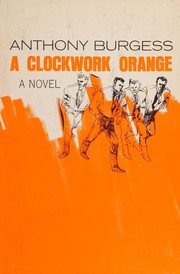 Anthony Burgess · 1962A Clockwork OrangeLvl 7Fast paced
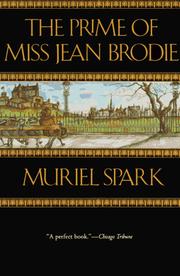 Muriel Spark · 1961The Prime of Miss Jean BrodieLvl 4Fast paced