
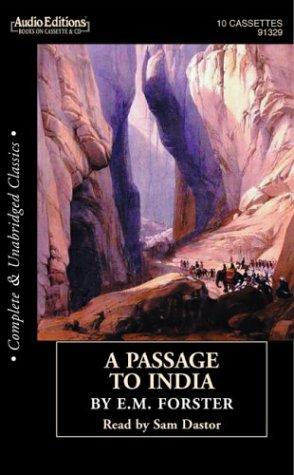
A Passage to India
E. M. Forster · 1879–1970 · England
Why it matters
A friendship across the colonial divide collapses around an ambiguous incident in the Marabar Caves and a courtroom. The great English novel of empire's impossibility, ending on the word 'No, not yet.'
At a glance
Ambiguous symbolism (the caves, the echo) resists a single settled reading.
Deep dive
What actually happened in the Marabar Caves — and why Forster built a whole novel around refusing to answer.
Written for readers who have finished the book. No plot recap, and nothing here is safe to read first.
Themes & symbolism
The caves' echo — a flat, meaningless "ou-boum" that swallows every word spoken into it, prayer and curse alike — is the novel's real antagonist: it collapses the distinctions (moral, verbal, spiritual) that both English rationalism and Anglo-Indian bureaucracy depend on to function. Mrs. Moore, previously the novel's warmest and most spiritually open character, hears it once and is undone by it, retreating into a nihilism she can't shake: "pathos, piety, courage — they exist, but are identical, and so is filth." What the caves represent isn't evil so much as indifference at the root of things, a universe that declines to organize itself around anyone's meaning, colonial or otherwise.
Forster structures the book in three parts — Mosque, Caves, Temple — that correspond loosely to Islam, the metaphysical void, and Hinduism, and the arrangement is itself an argument: order and hospitality (Aziz's world in Mosque) give way to an abyss that empties out meaning (Caves), which only the ecstatic, disorderly inclusiveness of the Hindu festival at Gokul Ashram (Temple) can answer, however provisionally. Real connection between Englishman and Indian is shown to be possible only outside the rational, administrative frame that Adela and the courtroom represent — which is exactly why Fielding and Aziz's friendship, tested honestly, still can't survive back inside it.
What Happened in the Caves
Forster never resolves what actually happens to Adela — whether she was assaulted by Aziz's guide, hallucinated the whole thing under the echo's disorienting influence, or experienced some kind of psychosexual panic about her own approaching, loveless marriage. That refusal is the point: the trial that follows isn't really an inquiry into truth, it's a colonial machine that requires a verdict regardless of what happened, and Forster's withholding forces the reader to sit in the same epistemological fog the caves themselves produce.
Fielding's Failure
Fielding, the novel's most sympathetic Englishman, stands for a liberal rationalism that genuinely wants to see Aziz as an equal — and the novel's real pessimism is reserved for him, not for the crude racists around him, because his good intentions still can't survive contact with a system built to prevent exactly the friendship he wants. Forster suggests that individual goodwill, however sincere, is not remotely sufficient against an institutional arrangement; Fielding's eventual, half-resigned integration into the colonial establishment he once resisted is as damning a verdict on liberal humanism as the trial itself is on the machinery of empire.
The last seal: what actually happens, and why it lands the way it does.
The ending, explained
After the trial's collapse, Fielding and Aziz go riding together and try, in good faith, to salvage their friendship on equal terms — but the landscape itself seems to refuse them, their horses swerving apart as rocks, a temple, a distant path physically intrude between them. The narration has the earth and sky answer for the men: "No, not yet," and the sky says "No, not there." It's less a statement about these two men than about the political condition surrounding them — genuine equal friendship between colonizer and colonized, Forster insists, isn't a matter of goodwill but of history, and history hasn't finished yet.
Where to go next
 E. M. Forster · 1910Howards EndLvl 5Medium pace
 Paul Scott · 1977Staying OnLvl 4Slow burn
 Zadie Smith · 2000White TeethLvl 5Medium pace
 Evelyn Waugh · 1945Brideshead RevisitedLvl 5Medium pace
 Muriel Spark · 1961The Prime of Miss Jean BrodieLvl 4Fast paced
 Iris Murdoch · 1978The Sea, the SeaLvl 6Slow burn