
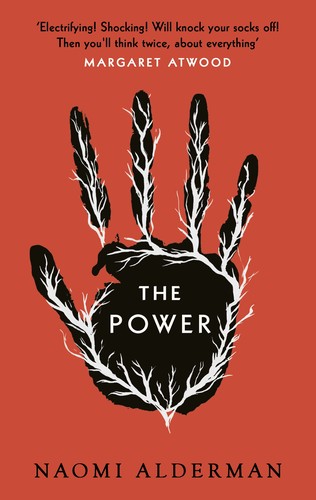
The Power
Naomi Alderman · b. 1974 · England
Why it matters
Teenage girls worldwide suddenly develop the ability to discharge lethal electric shocks, inverting the global gender hierarchy within a few years. A high-concept speculative thriller, framed as a manuscript reviewed five thousand years later, that takes power seriously as a corrupting force regardless of who holds it.
At a glance
A brisk, multi-viewpoint thriller structure carries a big premise at an accessible pace.
Deep dive
Teenage girls everywhere develop the power to kill with a touch, and Alderman spends the novel testing exactly how quickly a righted historical injustice curdles into a new one, framed as a five-thousand-year-old manuscript nobody in the future quite believes.
Written for readers who have finished the book. No plot recap, and nothing here is safe to read first.
Themes & symbolism
The skein, a new organ that lets women and girls discharge lethal electrical current, spreads globally within a single novel's timeframe, and Alderman refuses the easy version of that premise, a straightforward feminist wish fulfillment, in favor of tracking how fast the newly powerful start reproducing every abuse they'd just escaped. Roxy, daughter of a London gangster, Allie, a foster-care runaway who reinvents herself as the prophet Mother Eve, and Margot, an American politician who rides the power into national office, each chart a different route from vulnerability to dominance, and the novel is explicit that dominance, once achieved, behaves the same regardless of which sex is exercising it.
Tunde, the one major male viewpoint character, works as a journalist chronicling the power's spread, and his gradual transformation from documentarian to endangered outsider, harassed, assaulted, eventually hunted, gives the novel its clearest inversion of who gets to move safely through public space. Alderman uses his fear in exactly the ordinary, procedural way women's fear usually gets written, curfews, safety calculations, second-guessing which men in a room are dangerous, except now it's men doing the calculating.
The framing device, a novel-length manuscript by a male writer named Neil, submitted to a female mentor named Naomi roughly five thousand years after the events described, closes the loop with real bite: Naomi's editorial notes gently suggest the book would be more plausible, more marketable, if Neil published it under a woman's name, or at least paired it with a male pseudonym, and that reversed publishing condescension is Alderman's cleanest single joke about how thoroughly gendered assumptions about competence and authority survive any given distribution of actual physical power.
Bessapara as a Laboratory State
The fictional post-Soviet state of Bessapara, seized by women fleeing sex trafficking and consolidated under the dictator Tatiana Moskalev, gives Alderman a controlled environment for the novel's darkest material: a nation built explicitly on female power that produces its own purges, its own men stripped of legal rights, its own state violence, at a speed and scale the more diffuse Western settings can't match. Bessapara is where the novel stops arguing by inversion and starts arguing by acceleration, showing in miniature what the whole world is drifting toward.
The last seal: what actually happens, and why it lands the way it does.
The ending, explained
Roxy, betrayed and maimed by her own family's criminal rivalries, allies with Allie's Mother Eve movement and eventually helps trigger the Cataclysm, a catastrophic conflict in which women, now holding a decisive military and physical advantage, dismantle the existing global order through open war rather than negotiated reform. The novel's present-day plotlines dissolve into this larger convulsion rather than resolving individually, Tunde's fate left uncertain amid the violence he's spent the book documenting. The frame narrative confirms the new world order that follows is thoroughly matriarchal and, five thousand years on, just as capable of casual cruelty and enforced hierarchy as the patriarchy it replaced, which is the entire argument the manuscript form was built to deliver without a single lecture.
Where to go next
 Samantha Harvey · 2024OrbitalLvl 5Slow burn
 Bernardine Evaristo · 2019Girl, Woman, OtherLvl 4Fast paced
 Alan Hollinghurst · 2004The Line of BeautyLvl 5Slow burn
 Linda Grant · 2000When I Lived in Modern TimesLvl 5Medium pace
 Paul Lynch · 2023Prophet SongLvl 6Fast paced
 William Golding · 1954Lord of the FliesLvl 3Fast paced