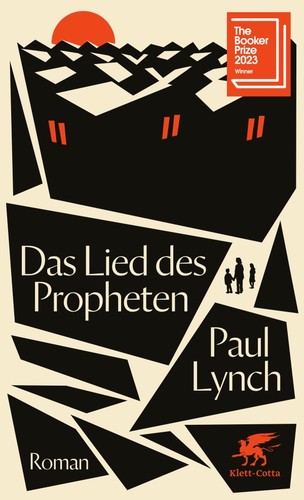
Prophet Song
Paul Lynch · b. 1977 · Ireland
Why it matters
As an emergency-powers regime hardens over Dublin, Eilish Stack's husband disappears into the secret police's files and her family into the logic of flight. The 2023 Booker winner: the refugee crisis brought home to a Western capital, without paragraph breaks or exits.
At a glance
Unparagraphed prose and unmarked dialogue sustain a deliberate, mounting claustrophobia.
Deep dive
Why Lynch denies you a single paragraph break for three hundred pages, and how a state's overreach gets absorbed by a rationalist family one manageable increment at a time until deferral stops being a choice.
Written for readers who have finished the book. No plot recap, and nothing here is safe to read first.
Themes & symbolism
The prose refuses you an exit on purpose: no paragraph breaks, no chapter breaks, dialogue folded into the running sentence without quotation marks, so that reading the book physically replicates what it's about — a life with no clear place to pause, breathe, or step outside the unfolding disaster. Eilish Stack is a molecular biologist, trained to weigh evidence dispassionately, and for the novel's first stretch she turns that rationalism against herself, explaining away a knock at the door, her husband's disappearance into the secret police's custody, a new curfew, each encroachment absorbed as an aberration rather than read as a pattern. Lynch's real subject isn't the emergency-powers regime so much as the ordinary cognitive machinery that lets a country normalize its own arrival, one manageable increment at a time.
Eilish's father Simon is losing his memory to dementia on a track that runs parallel to the state losing its mind to authoritarianism, and Lynch keeps cutting between the two erosions so private and civic unraveling read as the same phenomenon at different scales — a household and a country both forgetting, under duress, who they used to be. The title's biblical register, prophets whose warnings arrive and are ignored until it's too late, describes Eilish's own arc: a sister already resettled abroad, a friend who left early, become warnings she hears and defers acting on, again and again, until deferral stops being a choice she gets to make.
Each of Eilish's children absorbs the collapse differently, and the family's fracturing along those lines is the novel's clearest evidence that no household, however loving, survives a state's failure intact: one child radicalizes toward the resistance, another withdraws into silence, the youngest simply doesn't have the vocabulary yet for what's happening around him. Lynch resists giving any single response — flight, fight, denial — the moral high ground; the book's despair is precisely that none of the available reactions to encroaching authoritarianism turn out to be sufficient, only differently costly.
The View From Nowhere Safe
Lynch sets the collapse not in an invented country or a speculative future but in a Dublin built from real streets, real bus routes, recognizable chain shops and school runs — the emergency deepens on the DART line and outside actual filling stations, not behind the comfortable scrim of allegory. That specificity is the book's argument by other means: dystopian fiction usually lets Western readers watch catastrophe happen to a stand-in, somewhere else, filtered through someone else's unfamiliar institutions. Prophet Song won't grant that distance. By keeping the geography this legible, Lynch forces the reader to do the same math Eilish spends the whole novel resisting — to locate the checkpoints and curfew lines on a map they could actually walk themselves.
The last seal: what actually happens, and why it lands the way it does.
The ending, explained
Having lost her husband to the secret police and one son to the rebellion, Eilish finally makes the choice she spent the whole novel deferring: she gathers her surviving children and leaves, joining the convoys and boats of people fleeing the country's collapse into civil conflict. The scene deliberately echoes the imagery of refugee crossings usually reported from elsewhere, the West watching itself become the subject of that reporting rather than its audience. Lynch declines to grant the crossing a clean resolution — the emphasis falls on the bare fact of departure, an ordinary middle-class Dublin family reduced, in a few hundred pages, to exactly the kind of statistic Eilish once watched pass across the news.