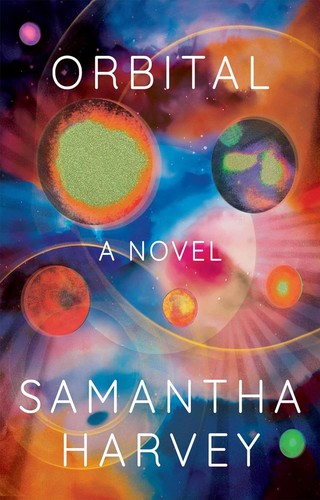
Orbital
Samantha Harvey · b. 1975 · England
Why it matters
Six astronauts circle the Earth sixteen times in a single day, watching a typhoon build while their small human griefs float with them. The 2024 Booker winner: a nearly plotless 'space pastoral' that turns planetary observation into devotion.
At a glance
Almost no plot; rapt, cumulative description asks to be read like poetry.
Deep dive
Why a novel where almost nothing happens keeps insisting that watching, closely enough, is its own form of devotion.
Written for readers who have finished the book. No plot recap, and nothing here is safe to read first.
Themes & symbolism
The crew experiences sixteen sunrises in a single day, and Harvey builds the novel against that fact rather than around it: the usual engine of plot, change accumulating over time, gets replaced by repetition and recurrence, so that the private, earthbound scale of a marriage fraying or a parent dying has to compete with a passing storm system for the reader's attention — and doesn't always win. Grief here arrives as an interruption to the day's larger rhythm rather than as its climax; one astronaut receives news, mid-orbit, that a parent has died, and the sheer physical impossibility of getting home in time to grieve on the ground becomes the novel's sharpest image of what the vantage costs its inhabitants.
The crew's official task is science, but the novel keeps drifting into a register closer to prayer — bodies pressed to the window, cataloguing coastlines and cloud systems and city lights at night in prose that borrows the cadence of litany more than of report. Harvey is writing in the tradition of the 'overview effect' astronauts have described since Apollo, the vantage that supposedly reorders proportion until national borders dissolve into a single blue, overexposed unit, and the typhoon gathering strength across the book's one day becomes the novel's closest approach to incident: a natural event the crew can watch build in real time and do nothing about, sublime and entirely indifferent to them.
The Documentary Method
Rather than chapters, the novel is loosely organized around the day's sixteen orbits, and the prose stays largely present-tense and observational, closer to a nature documentary's voiceover or a psalm's accumulation of praise than to a conventionally plotted novel with rising action. Characters are sketched through what they notice rather than through backstory delivered in scenes, and the method is a bet: that watching, patiently and exactly rendered, can carry a novel's emotional weight as well as event can. Reviewers reached for 'space pastoral' because the label fits — Orbital is less interested in what happens to its astronauts than in teaching the reader to look the way they've learned to look.
Six Nations, One Window
The crew is drawn from several countries, and the view from four hundred kilometers up dissolves the borders they were all trained to salute — yet the novel doesn't let that dissolution stand as the whole story. Radio calls back to separate mission controls, differing national holidays observed in miniature aboard the same small module, the discrete chains of command still governing who reports to whom: the geopolitics that vanish outside the window persist, quietly, inside the capsule. Harvey's interest isn't a utopian claim that height cures division: it's the more unsettling suggestion that even total, shared visual clarity about the planet's fragility doesn't automatically dissolve the systems built on top of it.