
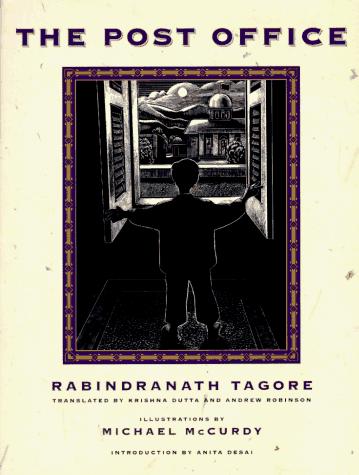
The Post Office
Rabindranath Tagore · 1861–1941 · India (Bengal)
Originally Dak Ghar (Bengali) · translated by Devabrata Mukerjea
Why it matters
A dying, housebound boy watches the world outside his window and waits for a letter from the King, delivered by the post office newly built across the street. Tagore's spare one-act play turns a child's confinement into a meditation on freedom.
At a glance
A short, simple one-act structure, though its ambiguous ending rewards a second read.
Deep dive
A sick boy confined to his room spends his days inventing friendships with everyone who passes his window and waiting for a letter from the King, and what the play does in its very last minutes with that waiting.
Written for readers who have finished the book. No plot recap, and nothing here is safe to read first.
Themes & symbolism
Amal, kept indoors under a doctor's orders he doesn't fully understand, turns his single window into the whole world: the curd-seller, the night watchman, the flower-girl Sudha, even the road itself become, in his telling, characters in an elaborate private mythology, and Tagore uses that inventiveness to make confinement legible not as tragedy but as a child's ordinary, resourceful way of living inside a limit adults have placed on him without explanation.
The King's new post office, built directly across from Amal's window, becomes his central fixation: he decides the King will personally write to him, and imagines himself, once well, working as the King's letter-carrier, delivering post to every village the way he currently receives news of the outside world secondhand through his window. The village headman's cruel joke, pretending to deliver a blank sheet as a royal letter, gives the play its one moment of adult malice aimed squarely at a dying child's fantasy, and Tagore doesn't soften how ugly the joke is before the real letter Amal has been waiting for arrives after all.
A Play Performed in the Warsaw Ghetto
In 1942, the physician and educator Janusz Korczak staged The Post Office with the Jewish orphans in his care in the Warsaw ghetto, days before the children were deported to Treblinka, a choice that has made the play's ending, a child accepting an arrival he can't control with something closer to wonder than fear, resonate historically far beyond anything Tagore could have intended when he wrote it in 1912 out of his own family's grief.
A Window That Does the Play's Work
Nearly the entire play happens through Amal's window rather than beyond it, and Tagore's staging choice, keeping the audience as confined to that one room as Amal is, means the play can only ever gesture at the wider world it keeps promising him, so that when the King's herald finally arrives in person, the effect depends entirely on how much the audience has come to share Amal's hunger for a threshold to finally open.
The last seal: what actually happens, and why it lands the way it does.
The ending, explained
As Amal's illness worsens, the Royal Physician arrives and, unexpectedly, a herald announces that the King himself is coming to visit personally, the very letter and audience Amal has spent the whole play imagining. As the household quiets and temple bells sound in the distance, Amal drifts into sleep, or something the play deliberately doesn't distinguish from sleep, just as Sudha arrives with flowers, promising she hasn't forgotten him. Tagore stages the moment without dread: the King's visit and Amal's fate are folded into the same arrival, the confinement of the sickroom finally opening onto something rather than simply ending, which is why the play has been read so often as being about a peaceful reconciliation with death rather than a tragedy of a child's wasted potential.
Where to go next
 Rabindranath Tagore · 1903Chokher BaliLvl 5Slow burn
 Rabindranath Tagore · 1910GoraLvl 5Slow burn
 Rabindranath Tagore · 1912GitanjaliLvl 3Slow burn
 Rabindranath Tagore · 1916The Home and the WorldLvl 6Medium pace
 Bankim Chandra Chattopadhyay · 1882AnandamathLvl 5Medium pace
 Sarat Chandra Chattopadhyay · 1917DevdasLvl 2Fast paced