
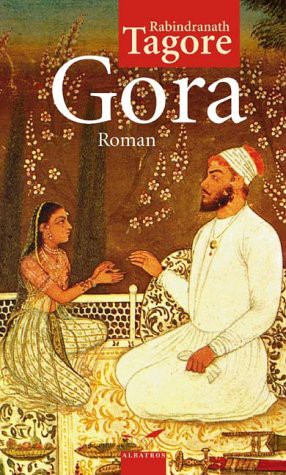
Gora
Rabindranath Tagore · 1861–1941 · India (Bengal)
Originally Gora (Bengali)
Why it matters
A fierce young Hindu nationalist crusades against caste laxity and foreign influence, certain of his own place at the center of Indian orthodoxy. Tagore's great novel of ideas wrestles with what it means to belong to India.
At a glance
A large ensemble cast and extended ideological debate slow an otherwise linear plot.
Deep dive
A fervent Hindu nationalist spends the whole novel defending an idea of birthright his own origins are quietly about to demolish.
Written for readers who have finished the book. No plot recap, and nothing here is safe to read first.
Themes & symbolism
Gora preaches an orthodox, exclusionary Hinduism built entirely on birth, caste purity, and ritual observance, a Bengal cleansed of Brahmo reformist influence and British interference alike, and Tagore spends the first two-thirds of the novel letting that conviction look almost admirable, a genuine, disciplined love of country rather than mere bigotry. His friendship with the more pragmatic Binoy, and his growing feeling for Sucharita, a Brahmo woman raised inside exactly the reformist household Gora despises, keep testing that conviction against actual people rather than abstractions, since Gora can maintain his theory of Hindu nationhood only as long as it stays theoretical.
The revelation that undoes him, that his mother Anandamoyi is not his birth mother at all, that he was born to Irish parents during the chaos of the 1857 rebellion and secretly adopted and raised as her own Hindu son, isn't a plot twist so much as Tagore's argument made literal: the nationalism Gora has built his identity around turns out to rest on an accident of parentage he never controlled and, by his own rigid logic, disqualifies him from the very caste and religion he has spent the novel defending. Tagore, a nationalist himself but a fierce critic of nationalism's exclusionary machinery, uses Gora's parentage to ask what an Indian identity built on something other than blood and caste would even look like.
A Twist That Argues Rather Than Surprises
Tagore plants Anandamoyi's secret early enough, in her own quiet refusal to observe caste rules around food and touch that Gora never questions, that an attentive reader can see the revelation coming well before Gora does, and that's deliberate: the point isn't shock but the gap between what the reader can see and what Gora's own ideology makes unthinkable to him, since his nationalism depends on never asking the question his mother's behavior keeps raising.
Brahmo Reform as the Novel's Second Argument
Sucharita's household, led by her guardian Paresh Babu, practices the Brahmo Samaj's reformed, monotheistic Hinduism, stripped of caste ritual and open to Western influence, and Tagore uses the running friction between Gora's orthodoxy and Paresh Babu's reform to stage the era's real intellectual battle over what a modernizing India should keep and discard, refusing to let either side simply win the argument before Gora's own crisis forces the question open.
The last seal: what actually happens, and why it lands the way it does.
The ending, explained
Anandamoyi finally tells Gora the truth about his birth, that he has no caste at all by the rules he has spent his life enforcing, and the revelation strips him of the very ground his nationalism stood on. Rather than collapsing into despair, Gora goes to Paresh Babu, the reformist he has spent the novel opposing, and asks to be received as any Indian would be regardless of caste or sect, a final gesture toward the more inclusive, non-sectarian idea of the nation Tagore has been building toward all along. His path toward Sucharita opens at the same moment his old identity dissolves, and the novel closes on that double release, an ideology's collapse doubling as a man's actual liberation.
Where to go next
 Rabindranath Tagore · 1903Chokher BaliLvl 5Slow burn
 Rabindranath Tagore · 1912GitanjaliLvl 3Slow burn
 Rabindranath Tagore · 1912The Post OfficeLvl 3Medium pace
 Rabindranath Tagore · 1916The Home and the WorldLvl 6Medium pace
 Bankim Chandra Chattopadhyay · 1882AnandamathLvl 5Medium pace
 Sarat Chandra Chattopadhyay · 1917DevdasLvl 2Fast paced